



(TechGenez) – 3I/ATLAS (C/2025 N1), a mysterious visitor from the stars is racing through our Solar System at breakneck speed, sparking wonder and wild speculation among astronomers. Detected on July 1, 2025, by the ATLAS telescope in Chile, 3I/ATLAS (C/2025 N1) is the third confirmed interstellar object ever observed, following ‘Oumuamua in 2017 and 2I/Borisov in 2019.
This icy wanderer, originating from another star system, is zipping along at over 200,000 km/h (61 km/s), offering a rare glimpse into the cosmos beyond our galactic neighborhood.
While most scientists hail it as a natural comet, Harvard astronomer Avi Loeb has ignited debate by proposing its unusual traits could signal extraterrestrial technology. As 3I/ATLAS hurtles toward the Sun, reaching its closest approach on October 30, the world watches: Is this just a cosmic snowball, or something far more extraordinary?
NASA’s confirmation as a comet has tempered the hype, but the object’s hyperbolic path—too fast to be trapped by the Sun’s gravity—promises invaluable data on distant star systems before it vanishes forever.
Discovery and Naming
On July 1, 2025, astronomers at the ATLAS (Asteroid Terrestrial-impact Last Alert System) survey telescope in Rio Hurtado, Chile, spotted a faint, fast-moving speck in the night sky. Initial observations revealed an object unlike any in our Solar System: unbound by the Sun’s gravity, it was an interstellar interloper.
Officially designated 3I/ATLAS (C/2025 N1), the name breaks down to “3” for the third interstellar object, “I” for interstellar, and “ATLAS” for the telescope network that caught it. The “C/” prefix confirms its comet status, based on early signs of activity like outgassing.
Hubble Space Telescope images from July 21, taken from 277 million miles away, captured its icy core enveloped in a coma—a luminous halo of gas and dust—cementing its comet identity.
This discovery, just the third of its kind, underscores the rarity of such visitors: interstellar objects are fleeting cosmic messengers, offering chemistry from alien worlds without the need for deep-space probes.
Speed and Trajectory
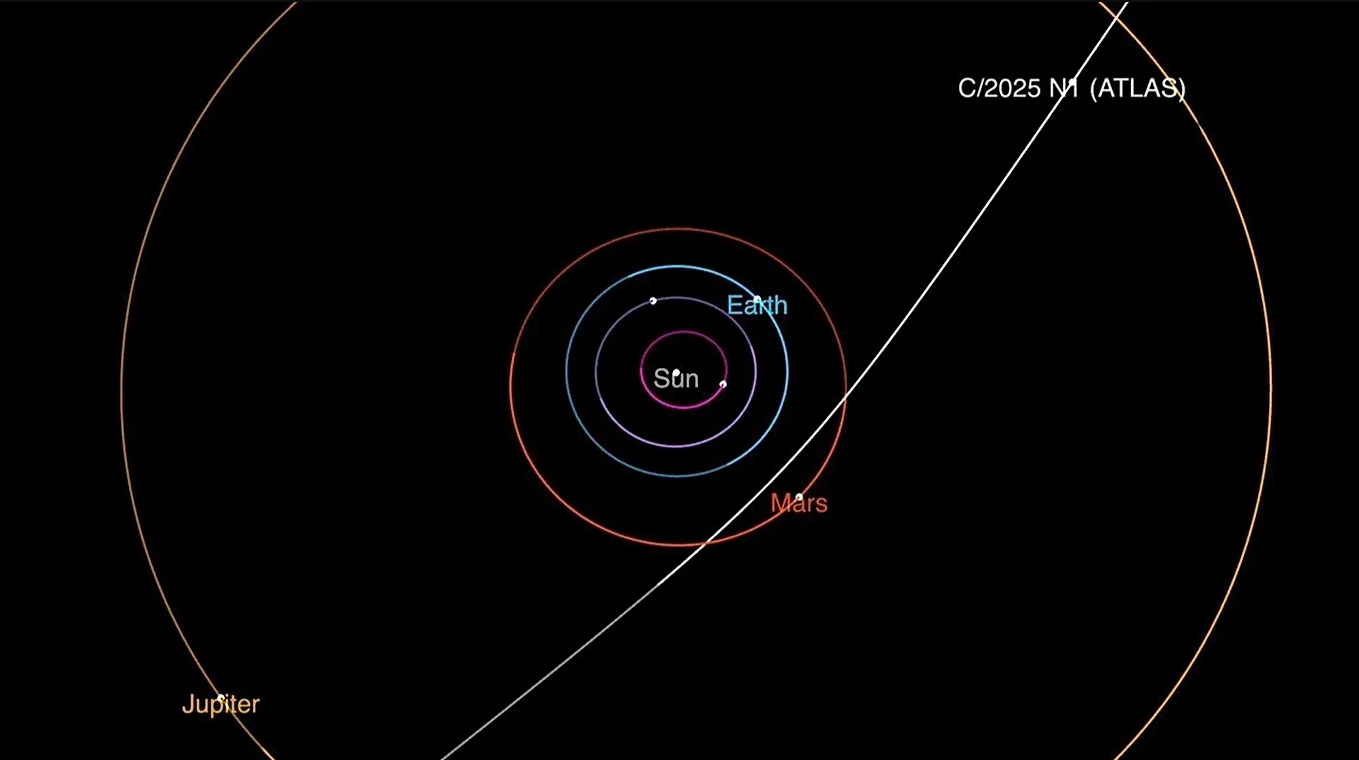
3I/ATLAS is a speed demon, clocking over 200,000 km/h (about 61 km/s), with its velocity ramping up as it nears the Sun. Its hyperbolic orbit—elongated and unbound—confirms its interstellar origin, meaning it will slingshot through our system and exit, never to return.
Currently traversing the inner Solar System between Mars and Earth’s orbit, it reached perihelion (closest to the Sun) on October 30, coming within 1.4 AU (about 130 million miles), just inside Mars’ path. Its closest approach to Earth was around 270 million kilometers, far enough to avoid collision but close enough for detailed study.
By early December, it should re-emerge from behind the Sun, visible to ground telescopes, before fading into the void. Comets director Con Stoitsis of the Astronomical Society of Victoria told The Guardian: “It’s going to kind of cruise through the inner solar system… and then it will fly past the sun. This one is on what we call a hyperbolic orbit. So it’s not gravitationally bound to the sun.”
This trajectory mirrors previous visitors: ‘Oumuamua’s cigar shape raised eyebrows, while Borisov’s comet-like tail was more familiar.
Size and Composition
Early estimates place 3I/ATLAS at several kilometers across, though precise measurements await further observations. Its composition screams comet: an icy core of frozen water, ammonia, and methane, surrounded by a coma of gas and dust from sublimation as it warms.
Observations show clear activity—outgassing and dust release—consistent with solar heating, unlike the inert ‘Oumuamua. NASA’s solar system small bodies lead, Tom Statler, told The Guardian: “It looks like a comet. It does comet things. It very, very strongly resembles, in just about every way, the comets that we know.”
This icy makeup suggests 3I/ATLAS formed in a distant, colder star system, carrying pristine materials untouched by our Sun’s heat for billions of years.
The Alien Tech Debate: Avi Loeb’s Bold Claim
Enter Harvard’s Avi Loeb, a theoretical astrophysicist and director of the Galileo Project, which hunts for extraterrestrial tech. In Medium essays and a paper titled “Is the interstellar object 3I/ATLAS alien technology?”, Loeb speculates the object’s brightness might stem from self-luminosity, not reflected sunlight—a trait unseen in natural comets.
He hypothesizes it could be an artificial probe or artifact from another civilization, with intentions benign, malign, or neutral, potentially warranting humanity’s defensive preparations. However, in a later blog post, Loeb conceded: “The simplest hypothesis is that 3I/ATLAS is a comet,” stressing his aim to challenge assumptions and foster curiosity: “Let us instead maintain our childhood curiosity and seek evidence rather than pretend to be the adults in the room that know the answers in advance.”
NASA firmly rejects the idea, with Statler emphasizing its comet-like behavior. The scientific consensus: 3I/ATLAS is a natural wanderer, not alien hardware, though Loeb’s ideas fuel public fascination and underscore the thrill of the unknown.
Scientific Significance and Future Observations
3I/ATLAS is a cosmic time capsule, carrying chemistry from another star system, offering clues to planet formation elsewhere. Unlike ‘Oumuamua’s odd shape or Borisov’s organic molecules, 3I/ATLAS’s activity allows real-time study of outgassing, revealing volatiles from its home system.
NASA and ESA telescopes, including Hubble, are tracking it, with ground observatories poised for December visibility. This data could refine models of interstellar migration and comet evolution.
As it exits, 3I/ATLAS reminds us of our galactic neighborhood’s vastness—interstellar objects may pass through every few years, per models, urging better detection networks.
Broader Implications
- This visitor reignites debate on extraterrestrial life: Loeb’s theories, while fringe, highlight the need for open-minded science, as seen in ‘Oumuamua’s SETI scans.
- It also spotlights ATLAS’s role in planetary defense, scanning for threats while spotting cosmic curiosities.
- For humanity, 3I/ATLAS is a humbling gift—a free sample from the stars, urging us to look up and wonder.
Quotes
Avi Loeb: “Let us maintain our childhood curiosity and seek evidence rather than pretend to know the answers in advance.”
Tom Statler, NASA: “It looks like a comet. It does comet things. It very, very strongly resembles the comets that we know.”
Con Stoitsis: “It’s going to cruise through the inner solar system and then fly past the sun… prompting a hyperbolic orbit.”
Broader Industry Trends
Interstellar object discoveries are accelerating: ATLAS and similar surveys have boosted detection rates 50% since 2017, per IAU.
AI in astronomy, like machine learning for trajectory prediction, aided 3I/ATLAS’s identification, per ESO.
Public fascination with alien tech, fueled by Loeb’s books, has spiked SETI funding 20% in 2025, per NSF data.
NASA’s budget for small bodies research rose 15% to $200 million in 2025, reflecting interest in visitors like 3I/ATLAS.
Outlook
3I/ATLAS will be visible again in early December, offering final observations before it fades. Data analysis could yield papers by mid-2026. Future surveys like Vera Rubin Observatory, launching 2025, may spot 10+ interstellar objects yearly, per models.
As Loeb urges, the real discovery is curiosity: 3I/ATLAS challenges us to question, observe, and dream of the stars.