





OpenAI announced on Friday that it will begin testing ads in ChatGPT for users on its free tier and the recently introduced lower-priced Go plan in the United States, marking the company’s first move to introduce advertising as a revenue stream for the popular AI chatbot.
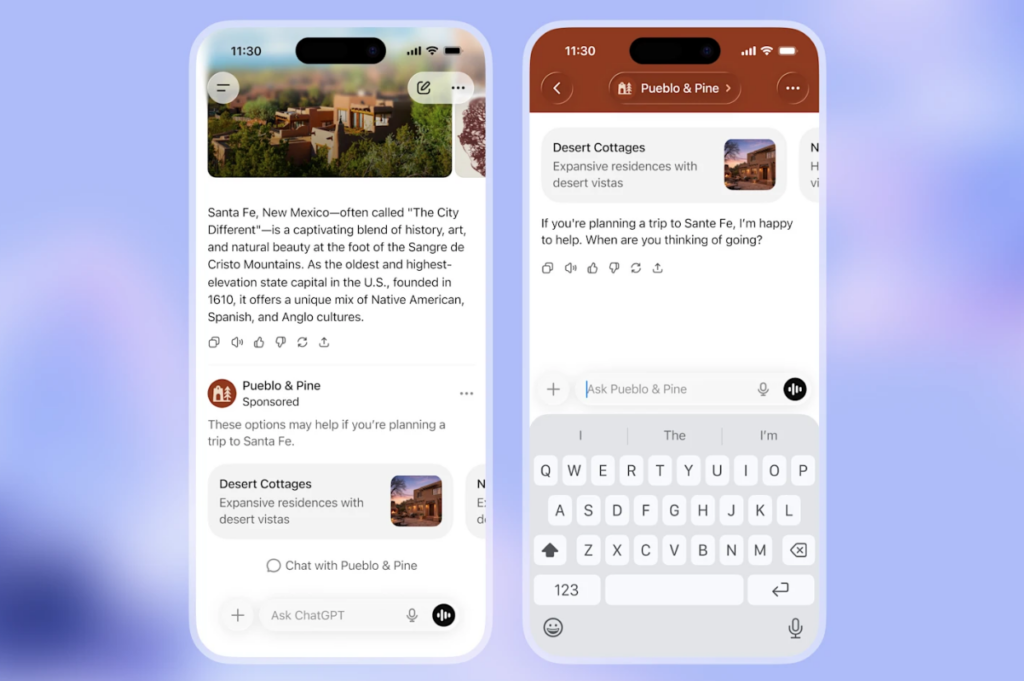
The ads will appear in the coming weeks as a separate element from ChatGPT’s generated responses, with no impact on answer quality or content. OpenAI emphasized that user conversations and personal data will not be shared with advertisers, maintaining its existing privacy commitments.
The step reflects growing pressure to monetize ChatGPT amid the massive computational costs of training and running frontier AI models, which run into the hundreds of millions of dollars annually.
Advertising Format and Scope
OpenAI stated that advertisements will be clearly distinguished from ChatGPT’s core responses and will not influence the AI’s output or reasoning process. The company has not disclosed specific ad formats, but they are expected to appear in non-disruptive locations such as side panels or between conversations.
The test begins with U.S. users on the free plan and the Go plan, which offers higher message limits and priority access at a lower price point than Plus or Pro tiers. The Go plan is currently expanding globally. OpenAI has committed to close monitoring of user feedback and performance metrics during the initial phase, with potential adjustments or expansion based on results.
Company Rationale
While ChatGPT Plus, Pro, and enterprise subscriptions generate significant revenue, the vast majority of users remain on the free tier. OpenAI has previously stated that supporting hundreds of millions of weekly active users requires diversified income sources beyond paid subscriptions.
The company stressed that ads will not compromise core principles: “User conversations remain private, and no personal data is shared with marketers.”
OpenAI also reiterated that advertising revenue will help fund continued development of safer, more capable AI systems.
Broader Context
ChatGPT, launched in late 2022, quickly reached 200 million weekly active users and became the fastest-growing consumer application in history. Monetization has relied heavily on premium subscriptions, API access, and enterprise deals.
Competitors including Google (Gemini), Anthropic (Claude), and xAI (Grok) have also explored advertising models, with varying approaches to integration.
The decision comes amid intense competition in generative AI, where development costs continue to escalate with each new model generation.
Challenges
Introducing ads risks alienating users who value ChatGPT’s clean, focused interface. Analysts warn that poorly implemented advertising could accelerate migration to ad-free alternatives. Privacy concerns remain central, especially after recent scrutiny of AI training data practices.
Balancing revenue needs with maintaining trust will be critical during the test phase.
Conclusion
OpenAI’s decision to test advertisements in ChatGPT represents a pivotal step toward long-term financial sustainability in the AI industry. While the approach prioritizes user privacy and response integrity, the coming weeks will reveal whether users embrace or reject this new monetization layer in one of the world’s most widely used AI tools.