



Tech giant Apple (AAPL.O) delivered a sales forecast for the upcoming holiday quarter that fell short of Wall Street expectations, causing its shares to dip by approximately 3% in after-hours trading.
The disappointing sales outlook was largely attributed to weak demand for iPads and wearables, areas where Apple typically garners substantial revenue during the holiday season.
Chief Executive Tim Cook, however, sought to reassure investors that the company’s latest iPhone 15 models were performing well in the vital Chinese market, assuaging concerns that Apple was losing market share to Huawei and other local smartphone competitors. Apple’s revenue from China saw a decline of 2.5% in the fiscal fourth quarter ending on September 30, although Cook mentioned that this decrease was offset by positive growth when accounting for foreign exchange rate fluctuations.
Chief Financial Officer Luca Maestri disclosed during a conference call that the sales outlook for the current quarter, which includes the crucial Christmas holiday period, is anticipated to be similar to the previous year. This projection did not align with Wall Street’s expectations, as analysts had anticipated a 4.97% increase in sales to reach $122.98 billion.
Apple’s shares, which had experienced a 37% increase in value over the year, faced a 3.4% decline in after-hours trading following the underwhelming forecast.
Maestri further explained that Apple predicts higher iPhone sales in the fiscal first quarter, despite the current holiday quarter having one less week of sales compared to the previous year.
Despite the confidence expressed by Tim Cook, some industry analysts remain cautious about Apple’s prospects in the Chinese market. Bob O’Donnell, chief analyst at TECHnalysis Research, noted, “I’d say it was surprising to see how confident Tim Cook was in future China’s performance given the many potential geopolitical challenges that we know exist for that market.”
Apple did provide some positive news, as the company reported sales and profit figures for the fiscal fourth quarter that exceeded Wall Street expectations. This outperformance was attributed to an uptick in iPhone sales and a notable $1 billion boost in services revenue, which offset significant drops in Mac and iPad sales.
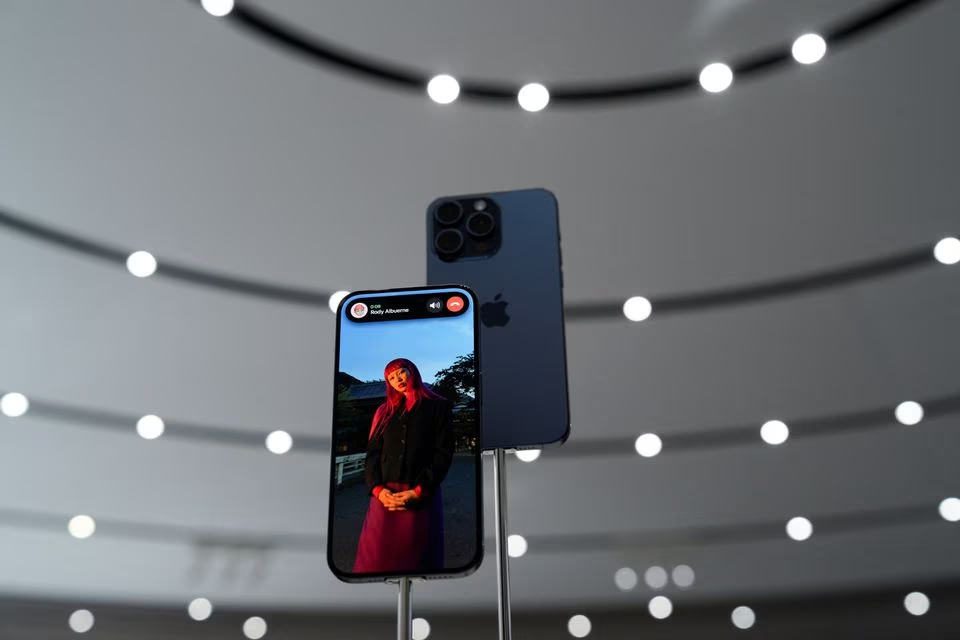
Cook acknowledged that the high-end iPhone models, the iPhone 15 Pro and Pro Max, were facing supply constraints. Apple has managed to navigate a global smartphone slowdown more successfully than many of its competitors, although it still contends with an uneven economic recovery in China, a critical market for the company.
The reported sales for the most recent quarter amounted to $89.50 billion, which was a slight decrease of about 1% compared to analyst estimates of $89.28 billion. Net income increased by approximately 11%, and earnings per share of $1.46 exceeded analyst expectations of $1.39 per share.
Apple faces intensified competition in the smartphone market this year, with Huawei Technologies making a comeback with new phones powered by Chinese-made chips after being largely excluded from the market for several years due to U.S. government trade restrictions.
Sales in China for Apple declined to $15.08 billion from $15.47 billion in the fourth quarter of the previous year. Cook emphasized that, after factoring in foreign exchange rate fluctuations, Apple’s business in China exhibited year-over-year growth, driven by strong iPhone sales and service revenue.
“In mainland China, we set a quarterly record for the September quarter for iPhone,” Cook highlighted. “We had four out of the top five best-selling smartphones in urban China.”
Apple is actively working to address supply constraints for the iPhone 15 Pro and Pro Max models, with Cook noting, “We do believe that later this quarter, we’ll reach a supply-demand balance.”
Despite the challenges, iPhone sales remain a significant contributor to Apple’s revenue, amounting to $43.81 billion in the fourth quarter, aligning with analyst expectations.
As supply issues are expected to be resolved in Apple’s fiscal first quarter, analysts anticipate improved performance in the upcoming period. IDC analyst Nabila Popal stated, “We expect its performance to further improve in Apple’s fiscal first quarter as the supply issues of the top Pro and Pro Max models will be resolved by then. Demand across regions continues to show a preference for the most premium models, and we expect an even larger proportion of those models this year than last year.”
Apple’s recent release of new Mac machines is also expected to invigorate the personal computer market.
Nevertheless, Mac sales experienced a significant decline of approximately one-third, amounting to $7.61 billion, and iPad sales decreased by 10% to $6.44 billion, falling short of expectations of $8.63 billion and $6.07 billion, respectively.
In the wearables segment, encompassing products such as the Apple Watch and AirPods, sales declined by 3% to $9.32 billion, missing estimates of $9.43 billion, according to LSEG data.
On a positive note, Apple’s services segment, including Apple TV+ and a recent deal with soccer superstar Lionel Messi, reported a 16% rise in revenue to $22.31 billion, surpassing analyst estimates of $21.35 billion.