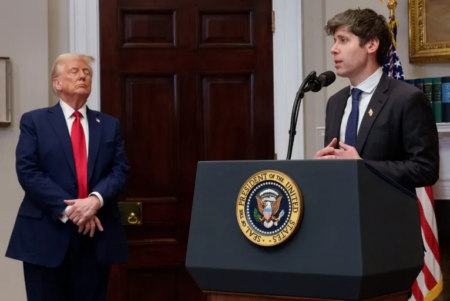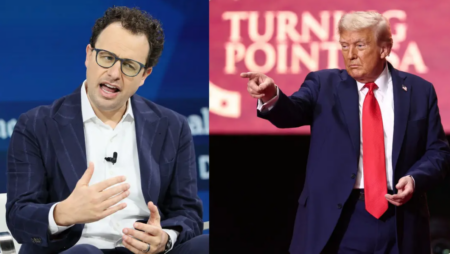



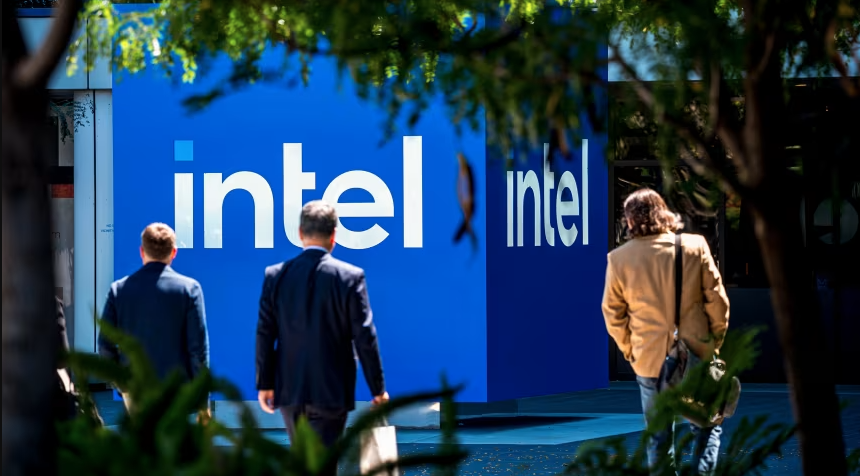
WASHINGTON – In a bold move to bolster U.S. semiconductor dominance, the Trump administration has acquired a 9.9% stake in Intel Corporation for $8.9 billion, announced on August 22, 2025, marking one of the largest government interventions in a private U.S. company since the 2008 auto industry bailout.
The deal, converting grants from the 2022 CHIPS and Science Act and Secure Enclave program into equity, aims to secure Intel’s role in national security and economic competitiveness, per The New York Times. With President Donald Trump hailing it as a “great deal for America,” the investment follows intense negotiations with Intel CEO Lip-Bu Tan and raises questions about government influence in corporate America. Here’s the latest on this historic agreement, its implications, and Intel’s path forward.
Details of the Intel Deal
The Trump administration’s $8.9 billion investment secures 433.3 million shares of Intel common stock at $20.47 per share, a discount from the $24.80 closing price on August 22, 2025, per Intel Newsroom. The funding comprises $5.7 billion in unpaid CHIPS Act grants and $3.2 billion from the Defense Department’s Secure Enclave program, building on $2.2 billion already received, totaling $11.1 billion, per NPR.
The government’s stake is passive, with no board representation or governance rights, and it agrees to vote with Intel’s board on shareholder matters, with limited exceptions, per Intel Newsroom. A five-year warrant for an additional 5% of shares at $20 is exercisable if Intel loses majority control of its foundry business, per CNN Business.
President Trump announced the deal on Truth Social, stating, “It is my Great Honor to report that the United States of America now fully owns and controls 10% of INTEL, a Great American Company that has an even more incredible future,” per PBS News. Commerce Secretary Howard Lutnick echoed this, posting on X, “BIG NEWS: The United States of America now owns 10% of Intel, one of our great American technology companies,” per CNBC. The deal, finalized after a White House meeting with Tan on August 11, 2025, follows Trump’s earlier call for Tan’s resignation over alleged China ties, a stance he later softened, per The Guardian.
Strategic Context: Why Intel?
Intel, the only U.S. company capable of producing advanced chips domestically, is critical to national security and economic goals, per Fox Business. Semiconductors power everything from smartphones to defense systems, and Intel’s struggles—reporting an $18.8 billion loss in 2024—have raised concerns about U.S. reliance on foreign chipmakers like Taiwan’s TSMC, per Reuters.
The CHIPS Act, signed in 2022, allocated $53 billion to revive U.S. semiconductor manufacturing, with Intel receiving $10.86 billion in grants, including $7.86 billion for projects in Arizona, New Mexico, Ohio, and Oregon, and $3 billion for Defense Department chips, per The New York Times.
The Trump administration, critical of the CHIPS Act as a “giveaway,” converted these grants into equity to ensure taxpayer returns, per NBC News. Trump’s broader semiconductor strategy includes 100% tariffs on foreign chips to incentivize domestic production, as seen in deals with Nvidia and AMD, which pay 15% of China chip sale revenues for export licenses, per CNN Business. The Intel investment aligns with plans to accelerate its Ohio factory hub, delayed due to funding and demand uncertainties, per Bloomberg.
Intel’s Challenges and Turnaround Efforts
Intel has faced significant hurdles, losing market share to Nvidia and AMD in AI chips and struggling to attract customers for its foundry business, per Reuters. CEO Lip-Bu Tan, appointed in March 2025, is tasked with a turnaround, cutting 15% of staff (over 20,000 jobs) and pausing projects in Germany and Poland, per CNBC. The Ohio factory, intended to be the world’s largest chipmaking facility, faces delays, with analysts questioning demand for its chips, per NPR. A $2 billion investment from SoftBank, announced August 19, 2025, complements the government’s stake, signaling confidence in Intel’s recovery, per The New York Times.
Tan emphasized Intel’s commitment, stating, “As the only semiconductor company that does leading-edge logic R&D and manufacturing in the U.S., Intel is deeply committed to ensuring the world’s most advanced technologies are American made,” per Intel Newsroom. However, analysts like Ben Bajarin of Creative Strategies warn that the government stake may not address Intel’s core issue: producing competitive chips that attract customers like Apple or Nvidia, per The New York Times.
Implications and Criticisms
The deal has sparked debate. Supporters, including Trump and Lutnick, argue it strengthens U.S. technological leadership and protects national security, per Fox Business. Patrick Moorhead of Moor Insights & Strategy told Fox Business, “Given the national security implications of having a domestic foundry… it would not surprise me if one of the options on the table is an investment in Intel,” per Fox Business. Intel’s stock rose 5.5% on August 22, reflecting investor optimism, per Reuters.
Critics, however, see risks in government overreach. Nancy Tengler of Laffer Tengler Investments told PBS News, “I don’t see the benefit to the American taxpayer, nor do I see the benefit, necessarily to the chip industry,” warning of potential meddling, per PBS News. A 2003 congressional study cited by NBC News cautioned that government stakes expose taxpayers to risk without guaranteed returns, per NBC News.
Future Outlook
The investment provides Intel with capital to stabilize its foundry business and Ohio projects, but its success hinges on attracting customers for its 14A and 18A manufacturing processes, per Reuters. Trump’s administration is exploring similar stakes in other critical industries, signaling a shift toward direct industrial policy, per CNN Business. Analysts like Kinngai Chan of Summit Insights argue that without major clients, “no government investment will change the fate of its foundry arm,” per Reuters.
As Intel navigates its turnaround, the government’s role as a major shareholder—valued at approximately $10 billion based on Intel’s $108 billion market cap—could reshape perceptions of the company as “too big to fail,” per The New York Times. Whether this deal catalyzes Intel’s revival or becomes a cautionary tale of government intervention remains to be seen.
Conclusion
The Trump administration’s $8.9 billion investment for a 9.9% stake in Intel, announced August 22, 2025, marks a historic shift in U.S. industrial policy, leveraging CHIPS Act and Secure Enclave funds to bolster domestic chipmaking.
Aimed at securing Intel’s role in national security and economic competitiveness, the deal follows intense negotiations with CEO Lip-Bu Tan and aligns with Trump’s tariff-driven push for U.S. manufacturing, per NPR. While supporters see it as a strategic win, critics warn of risks to taxpayers and corporate autonomy, per PBS News. As Intel battles to regain its edge, this unprecedented government partnership could redefine the U.S. tech landscape in 2025 and beyond.