




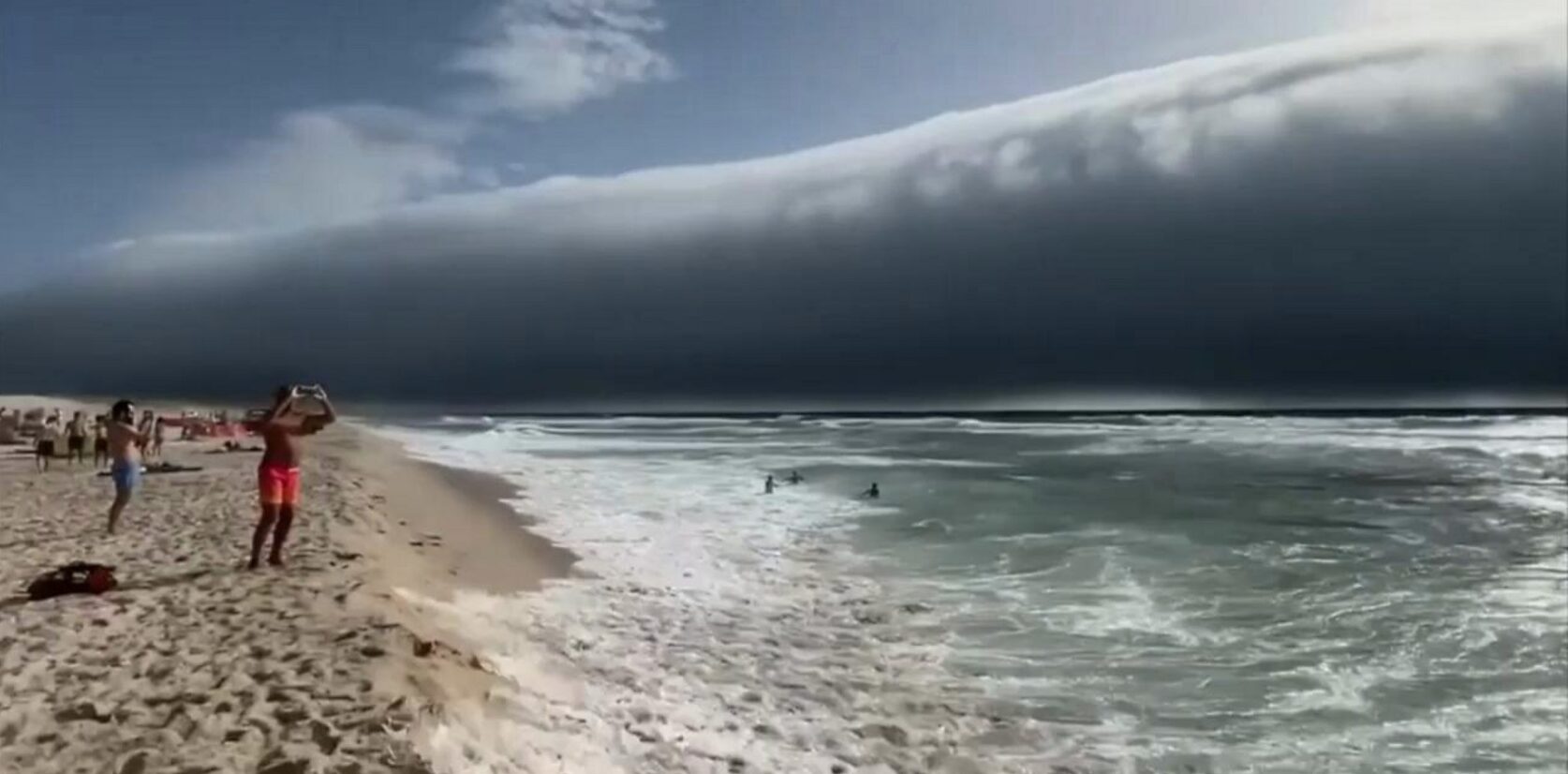
Roll Cloud – Beachgoers along Portugal’s northern and central coastline were treated to a mesmerizing and rare meteorological event on Sunday, June 29. What appeared to be a giant tsunami rolling through the sky left onlookers stunned, snapping photos and capturing videos that quickly went viral online.
The phenomenon, known scientifically as a “roll cloud,” is an uncommon type of arcus cloud that can span hundreds of miles and appears to roll across the sky like a horizontal tube.
One such dramatic sighting occurred at Buarcos beach in Figueira da Foz. Beachgoer Tiago Pinho, who filmed the phenomenon, expressed his amazement to the Associated Press: “See how quickly it came? There was a clear sky; it came in one minute.”
What Exactly is a Roll Cloud?
According to the U.S. National Weather Service, roll clouds are a subtype of arcus clouds that can form along the gust fronts of thunderstorms or cold fronts. Unlike shelf clouds, which are attached to a storm system, roll clouds are completely detached from the thunderstorm base, creating a tubular appearance that can span several miles.
Paulo Ceppi, a senior lecturer in climate science at Imperial College London, described the formation to The Washington Post: “These clouds are spectacular. They look massive, like it goes on forever, but they look scarier than they really are.”
While they may appear ominous, roll clouds do not typically result in dangerous weather. Their rarity, combined with their breathtaking formation, makes them a coveted sight among meteorologists and weather enthusiasts alike.
Climate Conditions That Fueled the Phenomenon
Portugal has been experiencing a stretch of extreme heat in recent weeks, part of a larger trend of rising temperatures across Europe. On the same day the roll cloud appeared, the central Portuguese region of Mora reported sweltering temperatures nearing 116 degrees Fahrenheit (46.7 Celsius), according to BGNES.
Experts suggest that the clash between the hot land temperatures and the cooler ocean air created the ideal atmospheric conditions for the roll cloud to develop. “The extreme heat combined with the colder ocean contributed to the perfect conditions,” said Ceppi.
Mário Marques, climatologist and founder of PlanoClima, added that the cloud didn’t move inland due to the intense heat radiating off the land. “It looks like a wave that’s stopped, always breaking on the same spot,” he explained to AP.
Could Roll Clouds Become More Common?
While this particular event dazzled spectators without causing harm, it has raised curiosity about whether such rare atmospheric displays might become more frequent in a warming world. Ceppi noted that while the roll cloud is not an immediate cause for concern, its occurrence could become more common as climate patterns shift.
“But it’s not particularly worrying or surprising. There are more worrying things about climate change,” Ceppi added.
A Natural Wonder Etched in Memory
For many beachgoers in Portugal, the appearance of the roll cloud offered a surreal moment of beauty and awe, standing in stark contrast to the summer’s oppressive heat. Though fleeting, such phenomena serve as a vivid reminder of nature’s power and unpredictability.
As social media users continue to share stunning images and videos of the event, meteorologists and climatologists are also taking note, using the rare occurrence as a case study in atmospheric behavior.