


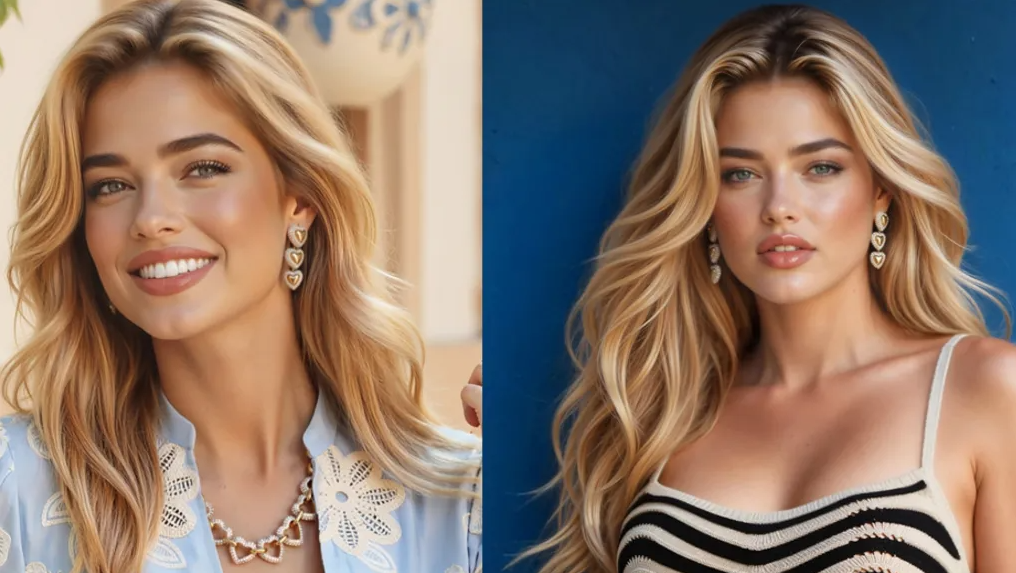
NEW YORK – Vogue’s August 2025 issue, featuring a two-page Guess advertisement with AI-generated models, has unleashed a firestorm of criticism from models, creatives, and fans. The ad, created by AI marketing agency Seraphinne Vallora, showcases a flawless blonde model in a striped dress and floral playsuit, marked by a subtle disclaimer: “Produced by Seraphinne Vallora on AI.”
While Vogue insists it was not an editorial decision, the inclusion of AI models has sparked accusations of undermining human models, threatening industry jobs, and perpetuating unattainable beauty standards. As calls for boycotts and subscription cancellations flood social media, the controversy raises urgent questions about AI’s role in fashion and its impact on diversity and creativity.
The Guess Ad: AI Models in Vogue’s Spotlight
The controversial advertisement, appearing halfway through Vogue’s August issue, features a blonde model named Vivienne, digitally created by Seraphinne Vallora. In one image, she sits at a café in a light blue floral playsuit; in another, she leans against a wall in a black-and-white chevron dress, clutching a Guess handbag.
The fine print identifying the model as AI-generated caught the attention of eagle-eyed readers, triggering a viral backlash on X and other platforms. The ad, commissioned by Guess co-founder Paul Marciano, who contacted Seraphinne Vallora via Instagram, marks the first time an AI-generated person has appeared in American Vogue’s pages, per CNN.
Seraphinne Vallora, founded by former architects Valentina Gonzalez and Andreea Petrescu, spent weeks crafting the ad, using a real model’s poses to inform the AI-generated imagery for optimal product display, per BBC. The agency, which charges up to six figures for campaigns, has also worked with Elle and Harper’s Bazaar, per Daily Mail. While Guess aimed to leverage AI for cost-effective, high-quality visuals, the move has drawn fierce criticism for sidelining human talent.
Backlash from Models and Fans
The reaction on X was swift and scathing. Users like @CANDYN3CKLCE called for a boycott, tweeting, “Boycott Vogue NOW! They’re pushing out models for AI, devaluing hard work and art of real people.” Another user, @WEBBYMCGEE, posted, “Had to end the Vogue magazine subscription I’ve had for years because the latest magazine used AI models ??? In Vogue? AI models in Vogue?” Plus-size model Felicity Hayward, a 13-year industry veteran, told The Independent, “It’s lazy and cheap. This could undermine years of work towards more diversity in fashion.” She expressed concern for job losses among models, photographers, makeup artists, and set designers.
Fans echoed these sentiments, lamenting the loss of human artistry. A Reddit user on r/popculturechat wrote, “Models didn’t survive the eating disorder era just to get replaced by AI,” highlighting the emotional toll on aspiring models. Another commented, “It’s a huge risk for creatives and behind-the-scenes people… models are paid the least and are easily disposable.” Gen Z readers, in particular, voiced a craving for authenticity, with one X user noting, “My daughter canceled her Vogue subscription. She wants real models, not AI.”
Impact on Diversity and Beauty Standards
The controversy has reignited concerns about diversity and beauty standards. The fashion industry made strides in the 2010s, with milestones like Valentina Sampaio as the first openly trans model for Victoria’s Secret and Halima Aden as the first hijab-wearing model in global campaigns, per BBC. Critics argue AI models, like Vivienne, reinforce Eurocentric ideals—light skin, straight hair, and hyper-symmetrical features—undoing progress toward inclusivity.
Vanessa Longley, CEO of eating disorder charity Beat, told BBC, “Exposure to unrealistic bodies can affect body image and increase the risk of eating disorders.” A 2024 Dove report cited by ABC News noted that 50% of Australian women feel pressured to alter their appearance due to online imagery, even when identified as fake or AI-generated.
Dr. Rashmita Bardalai of RMIT University emphasized the need for AI to be trained on diverse datasets to avoid perpetuating “outdated beauty norms,” per ABC News. However, Seraphinne Vallora’s founders claimed their AI model looks “quite realistic” and rejected accusations of unattainable standards, per AI Magazine. Critics like Hayward argue that AI models disproportionately harm plus-size and marginalized models, who already face barriers in the industry.
Industry Implications: Jobs and Ethics
The use of AI models threatens the livelihoods of not just models but entire creative teams. Dr. Jade McSorley of the Centre for Sustainable Fashion told Forbes, “The personality you bring to images is diminished alongside the co-creative process with the whole team.”
AI can cut campaign costs by up to 70% and reduce lead times from months to days, per Forbes, appealing to CFOs but alienating creatives. Seraphinne Vallora’s process, involving five employees and up to a month of work, still bypasses traditional roles like casting directors and retouchers, per Vogue.
Vogue’s partnership with OpenAI, announced in July 2025, allowing content integration into ChatGPT search results, has intensified scrutiny. Condé Nast’s CEO, Roger Lynch, called it “crucial” to embrace new technologies, per The New York Times. However, critics argue this move normalizes AI in fashion, with one X user stating, “If Vogue is doing this, smaller magazines will follow, making AI ad slots standard.”
Defenders of AI in Fashion
Not all reactions were negative. Seraphinne Vallora’s founders told CNN that their goal is not to replace traditional methods but to offer a “creative alternative” that’s faster and cheaper. They highlighted using a real model’s poses to inform AI imagery, ensuring realistic product representation.
Fashion-tech journalist Maghan McDowell told Forbes, “The conversation that AI art is inherently bad is not true. It’s about how it’s used.” Former model Sinead Bovell, writing for Vogue in 2020, predicted AI could democratize fashion by allowing consumers to create personal avatars to test clothing fit, per BBC.
Some see AI as a sustainability win, reducing the need for travel and physical shoots. Seraphinne Vallora expects demand for AI models to “explode” in coming years, per ABC News. However, they stress clear labeling, which is not legally required in the U.S. or Australia, to maintain transparency.
The Future of Fashion and Vogue’s Role
The backlash has sparked calls for regulation. Dr. Bardalai advocated for mandatory labeling of AI-generated imagery to protect consumers and creatives, per ABC News. The Butterfly Foundation’s Melissa Wilton warned of AI’s potential to exacerbate disordered eating, urging brands to prioritize human models, per ABC News. Meanwhile, Vogue’s decision to run the ad, even if not editorial, has drawn comparisons to past controversies, like Levi’s 2023 AI model campaign, which critics called a shortcut to diversity, per Jezebel.
X users referenced Anna Wintour’s legacy, with @LindaraschkelM tweeting, “Anna Wintour would be disgusted by this,” suggesting Vogue’s shift post-Wintour’s retirement as editor-in-chief in 2025 has fueled the controversy. Fast Company noted that Vogue Portugal and Vogue Italia used AI-generated models or backgrounds in 2023 and 2024, indicating a broader trend.
Conclusion
Vogue’s August 2025 Guess ad featuring AI-generated models has unleashed a fierce debate, with models like Felicity Hayward and fans decrying the threat to jobs, diversity, and authentic artistry. While Seraphinne Vallora defends AI as a cost-effective, creative tool, critics argue it perpetuates unrealistic beauty standards and risks alienating Gen Z readers who crave real human stories.
As Vogue navigates its OpenAI partnership and the fallout from subscription cancellations, the fashion industry faces a pivotal moment: embrace AI’s efficiency or preserve the human essence of creativity. With calls for regulation and boycotts growing, Vogue’s next move will shape the future of fashion media.