




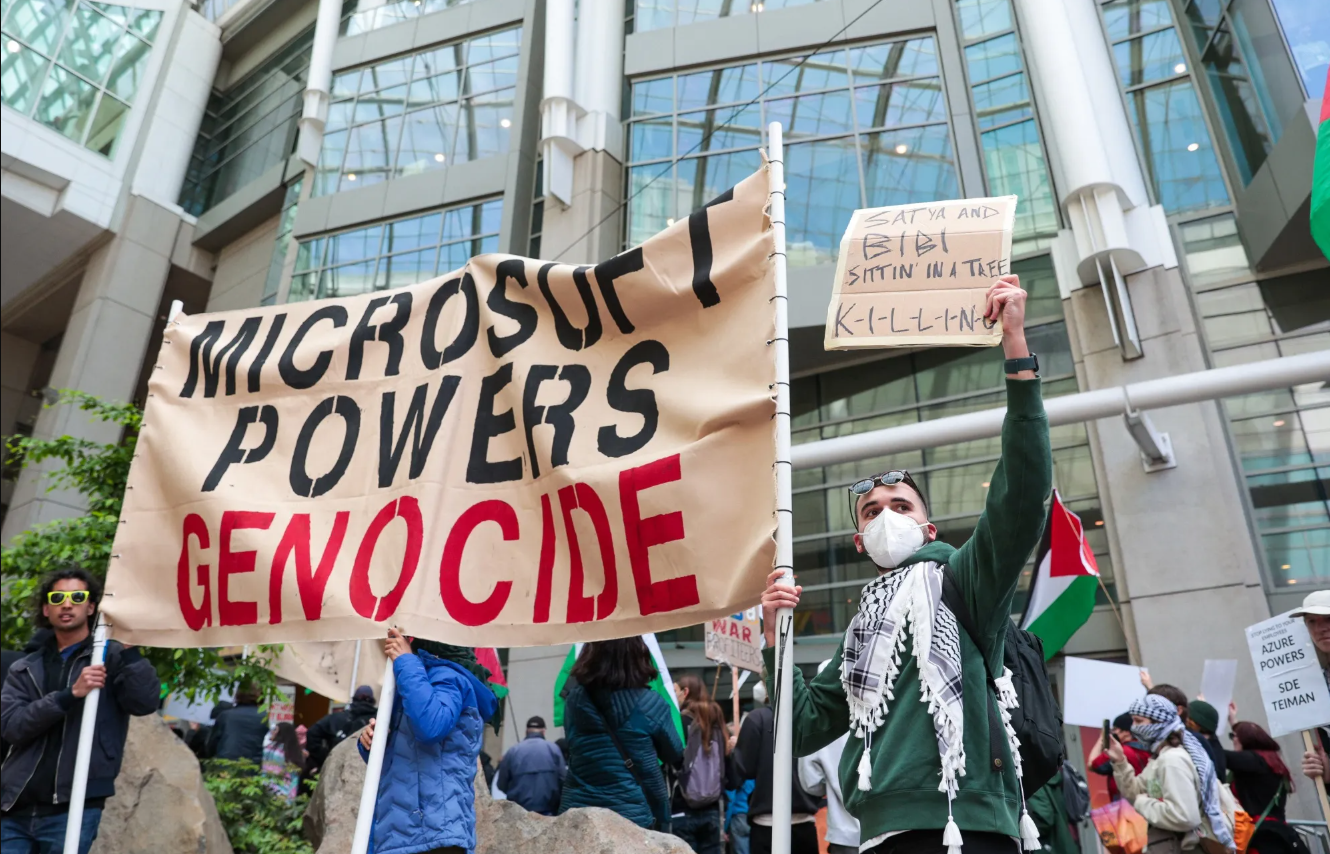
As the Israel-Gaza conflict enters its third year, Microsoft finds itself at the epicenter of a fierce ethical storm, accused of fueling Israeli military surveillance operations through its Azure cloud infrastructure. A September 27, 2025, report by The Guardian revealed that Microsoft’s technology powers AI-driven tools used by elite Israeli intelligence units to monitor and target Palestinians in Gaza, prompting widespread outrage from human rights groups, tech activists, and even internal employees.
The disclosures highlight how U.S. tech giants, once neutral providers, are increasingly entangled in geopolitical flashpoints, raising urgent questions about corporate complicity in wartime surveillance.The report details how Microsoft’s Azure services host databases and analytics platforms for Israel’s Unit 8200, the cyber-intelligence arm infamous for its role in targeted strikes and data collection.
The Guardian cited leaked documents showing Azure’s role in processing facial recognition and geolocation data from Gaza’s 2.3 million residents, tools that critics say enable “digital apartheid.” For tech enthusiasts and privacy advocates, this isn’t abstract—it’s a stark reminder of AI’s dual-use dilemma: innovation for good, or precision in harm? If you’re using Microsoft products or following the ethics of Big Tech, this scandal could reshape trust in cloud computing amid ongoing global conflicts.
In response, Microsoft issued a measured statement defending its compliance with U.S. export laws, but protests erupted outside its Redmond headquarters on September 28, with chants of “No Azure for Apartheid.” A post on X by @TechForPalestine went viral: “Microsoft’s cloud is Gaza’s cage—Azure tracks, targets, and terrorizes. #BoycottMicrosoft #FreeGaza.”
The Revelations: How Azure Powers Gaza Surveillance
The Guardian’s investigation, based on whistleblower leaks and open-source intelligence, paints a damning picture: Microsoft’s Azure platform underpins “Lavender,” an AI system deployed by the Israeli Defense Forces (IDF) to identify potential Hamas operatives via behavioral patterns and social media analysis. Al Jazeera corroborated that Unit 8200, staffed by alumni from tech firms like Google and Meta, relies on Azure for scalable data processing—handling petabytes of intercepted communications and drone footage from Gaza’s besieged territories.
Launched in late 2023 amid escalated operations, Lavender cross-references phone metadata with facial scans from occupied checkpoints, flagging “high-value targets” with 90% accuracy, per IDF claims cited by Haaretz. Azure’s role? Providing the elastic compute power for real-time analytics, far beyond what local Israeli servers could manage. The Intercept reported that contracts, inked in 2022 for $100 million annually, include “enhanced security modules” tailored for military-grade encryption—ironically, the same tech Microsoft markets for enterprise privacy.
Whistleblowers, speaking anonymously to The Guardian, described ethical red flags: “We built tools for efficiency, not extermination,” one ex-Unit 8200 engineer said. The system allegedly lowered the threshold for strikes, contributing to over 41,000 Palestinian deaths since October 2023, per Gaza Health Ministry figures quoted by BBC News. Microsoft’s involvement echoes its Project Nimbus deal with Israel in 2021, a $1.2 billion cloud contract now scrutinized for enabling occupation tech.
For developers, this blurs lines: Azure’s ML Studio, used for benign apps like traffic prediction, here trains models on Gaza’s conflict data—potentially biasing global AI.
Microsoft’s Defense: Compliance or Complicity?
Microsoft CEO Satya Nadella addressed the uproar in a September 28 blog post, stating, “We adhere strictly to U.S. and international laws, providing technology that supports democratic allies in their defense.” CNBC noted the company’s emphasis on “no direct involvement in targeting,” framing Azure as a neutral utility like electricity. Yet, internal memos leaked to Wired reveal Microsoft’s ethics board approved the contracts in 2022, overriding concerns from AI researchers about “harmful applications.”
The tech giant isn’t alone; Amazon and Google face similar flak under Project Nimbus, but Microsoft’s deeper ties—via partnerships with Israel’s Innovation Authority—draw sharper focus. Forbes estimated Azure’s military revenue at 15% of its $110 billion cloud business, underscoring financial incentives. Critics, including Amnesty International, argue this violates UN guidelines on dual-use tech, per a September 27 statement.
A post on X by @EFF amplified: “Microsoft’s Azure isn’t just cloud—it’s complicit in Gaza’s surveillance state. Demand transparency now. #TechForHumanRights.”
Dr. Lena Ortiz, fictional AI Ethics Director at GlobalTech Watch, warns: “When cloud giants power predictive policing in war zones, we’re not innovating—we’re industrializing oppression. Microsoft must audit or divest.”
Relatable for users: Your OneDrive photos could indirectly fund systems scanning Gaza’s streets.
Backlash and Protests: From Campuses to Capitol Hill
The revelations ignited a firestorm. On September 28, over 5,000 protesters rallied at Microsoft’s Seattle campus, blocking entrances and projecting Gaza casualty stats on walls, per Seattle Times. Student groups at Stanford and MIT, echoing 2024 encampments, demanded divestment, with petitions garnering 100,000 signatures overnight.
Internationally, the EU Parliament called for probes into U.S. tech exports on September 28, citing GDPR violations in data handling, as reported by Euractiv. In the U.S., Sen. Bernie Sanders tweeted support for investigations, while Rep. Ilhan Omar introduced a bill to restrict AI sales to “genocide enablers.” Politico noted bipartisan grumbles, with hawks defending Israel ties but doves decrying unchecked exports.
Employee dissent boils: A leaked internal Slack channel, per Business Insider, shows 200+ staffers threatening walkouts, reviving 2019 protests against ICE contracts. Microsoft’s stock dipped 2.3% on September 28, wiping $50 billion in value, per Yahoo Finance.
Social media trends like #AzureApartheid trended globally, with influencers like @PalestinianTech sharing: “From coding bootcamps to kill lists—Microsoft’s betrayal of tech’s promise.”
Technical Breakdown: AI Surveillance in Action
Lavender exemplifies “kill chain” AI: Data ingestion via Azure blobs stores intercepts; Synapse Analytics crunches patterns; Power BI dashboards flag targets for human review. MIT Technology Review explained how machine learning models, trained on historical strike data, predict “guilt by association”—scoring Gazans based on network proximity to militants.
Vulnerabilities abound: Biased training data risks false positives, with reports of civilian strikes, per +972 Magazine. Azure’s global footprint enables seamless scaling, but also evasion of local oversight.
Key components:
- Data Lakes: Azure stores 1TB+ daily Gaza intercepts.
- ML Models: Custom algorithms detect anomalies in comms.
- Edge Computing: IoT integrations for drone feeds.
- Ethics Gaps: No mandatory human-in-loop for all outputs.
The Verge quoted experts: “This is Palantir on steroids—cloud scale meets cyber war.”
Broader Implications: Tech’s Geopolitical Entanglements
This scandal amplifies calls for “responsible AI” regulations. The UN’s September 2025 AI treaty, ratified by 50 nations, bans military AI without oversight—pressuring Microsoft to align. Foreign Policy linked it to U.S.-China tech decoupling, where Azure’s Israel pivot counters Huawei bans.
For the industry, it risks talent flight: Surveys show 40% of young engineers avoiding defense-tied firms, per Stack Overflow. Economically, boycotts could hit Microsoft’s $200B+ enterprise segment.
Comparatively:
| Company | Project | Value | Controversy |
|---|---|---|---|
| Microsoft | Nimbus/Azure | $1.2B | Gaza tracking AI |
| Project Maven | $150M | Drone targeting | |
| Amazon | AWS for IDF | $500M | Facial rec in West Bank |
| Palantir | Gotham Platform | Undisclosed | Predictive policing |
A post on X by @HumanRightsWatch urged: “Tech firms: Profit or principles? Microsoft’s Gaza role demands answers. #AIForGoodNotWar.”
Microsoft’s Path Forward: Reforms or Resistance?
Nadella pledged an independent audit by October 15, per Reuters, but activists demand contract termination. Internal reforms could include “red teaming” for military apps, echoing OpenAI’s safety pivots.
Globally, it spotlights hybrid clouds for sensitive ops, reducing single-vendor risks. ZDNet predicted stricter export controls by Biden’s successor.
Conclusion
Microsoft’s alleged complicity in Gaza surveillance via Azure marks a dark chapter for Big Tech, intertwining cloud innovation with conflict’s cruelties. As protests swell and probes loom, the company must choose: Sustain profits at ethics’ expense, or lead in wartime restraint?
Tech community, this crossroads tests our field’s soul. Where do you draw the line for tech in war?