




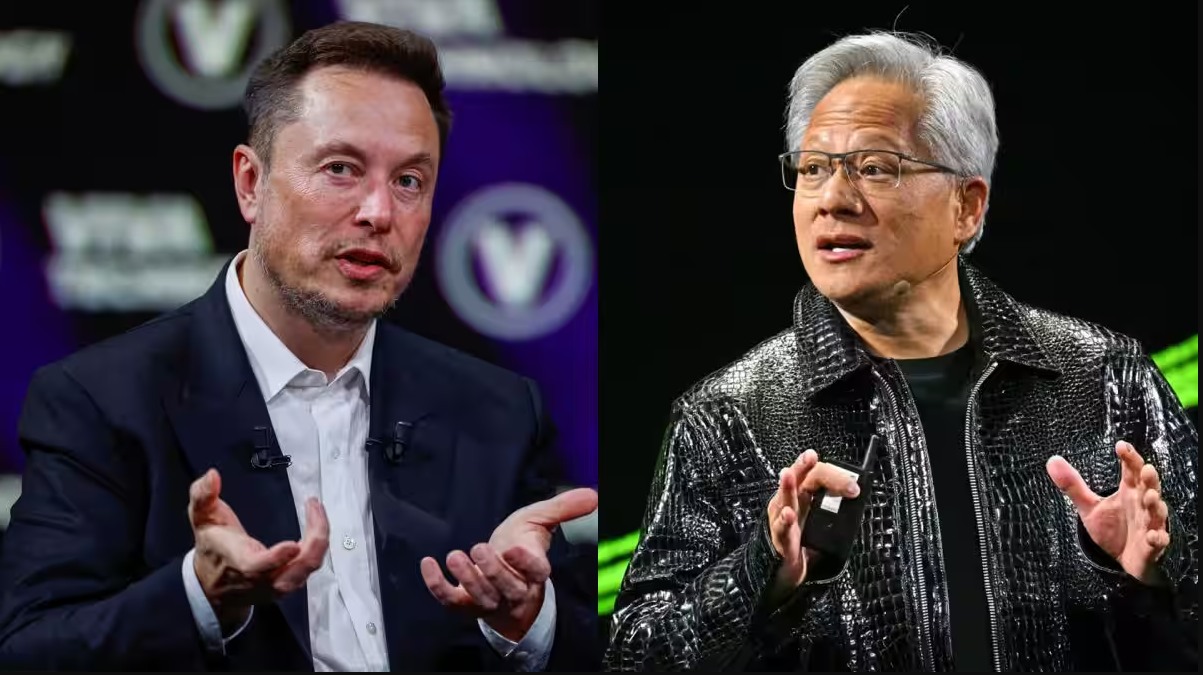
Nvidia Corp has agreed to invest $2 billion in Elon Musk’s artificial intelligence startup xAI as part of a $20 billion funding round to support the construction of the Colossus 2 data center in Memphis, Tennessee, people familiar with the matter said on Tuesday.
The financing, one of the largest in AI history, combines $7.5 billion in equity and up to $12.5 billion in debt, structured through a special-purpose vehicle (SPV) to purchase Nvidia graphics processing units (GPUs), according to sources cited by Bloomberg and The Wall Street Journal. The SPV allows investors to fund the chips, which xAI will lease for five years, ensuring returns through rental payments.
The deal strengthens Nvidia’s role as a key enabler of AI infrastructure while securing chip demand amid competition from OpenAI and Google. xAI, founded in 2023 to advance “truth-seeking” AI, faces escalating compute costs, with monthly spending of approximately $1 billion, sources said.
Deal Terms
The $20 billion round includes equity from Nvidia, Valor Capital Group, Apollo Global Management, and Diameter Capital Partners, with Nvidia’s $2 billion stake anchoring the deal.
The SPV will acquire Nvidia GPUs, which xAI will rent for five years, reducing upfront costs while providing investors stable returns, sources told Bloomberg. The structure mirrors Nvidia’s financing deals with other AI firms, ensuring chip supply for compute-intensive projects.
xAI’s Series B round in May raised $6 billion at a $24 billion valuation. The current financing will expand the Colossus supercomputer, aiming for a gigawatt-scale AI training cluster to power xAI’s Grok chatbot and future models.
Musk has proposed Tesla invest in xAI, with a shareholder vote scheduled for Q4 2025, according to company filings.
Company Response
Nvidia declined to comment on the investment specifics. xAI did not immediately respond to requests for comment. In a September post on X, Musk said xAI was “not raising any capital right now,” a claim sources attributed to ongoing negotiations that accelerated as GPU costs mounted.
xAI’s Grok, a rival to OpenAI’s ChatGPT, integrates with Musk’s X platform, serving millions of users seeking real-time answers.
Quotes
Nvidia CEO Jensen Huang told CNBC on Tuesday: “Almost everything that Elon’s part of, you really want to be part of as well. He gave us the opportunity to invest in xAI, and I’m just delighted by that.”
Edward Ludlow wrote on LinkedIn: “xAI needs a way to finance all the GPUs for its next big data center — Colossus 2 in Memphis. The twist is that investors aren’t backing xAI directly — they’re backing the chips.”
Broader Context
Nvidia’s investment follows its $100 billion commitment to OpenAI in September for data center expansion, part of a strategy to fund AI customers and lock in chip orders.
xAI’s Colossus, powered by 100,000 Nvidia H100 GPUs, is among the largest AI training clusters globally. Colossus 2, planned for Memphis, will scale further, requiring significant power and hardware, per industry estimates.
Musk, who co-founded OpenAI before leaving in 2018 over strategic disagreements, has built xAI with talent from Google DeepMind, Meta, and Anthropic, positioning it to challenge AI leaders. U.S.-China trade restrictions, limiting Nvidia’s chip exports, have driven investments in domestic AI firms like xAI, which benefits from U.S. CHIPS Act incentives.
The AI sector’s capital demands are immense: xAI’s $1 billion monthly compute spend reflects GPU costs averaging $30,000 each, according to market data.
Market Reaction
Nvidia shares fell 0.2% to $184.12 in New York trading on Tuesday, reflecting tech sector volatility. xAI, privately held, does not trade publicly. Microsoft, a potential xAI cloud partner via Azure, saw shares dip 0.3%. Analysts view Nvidia’s investment as positive for long-term chip demand.
Wedbush Securities’ Daniel Ives said in a note: “Nvidia’s stake in xAI secures GPU supply chains while aligning with Musk’s ambitious AI roadmap.” Retail sentiment on StockTwits was “bearish” for Nvidia and “extremely bearish” for xAI, citing concerns over valuation dilution and competitive pressures.
Challenges
The deal faces U.S. antitrust scrutiny due to Nvidia’s 80-90% dominance in AI chips, with regulators probing its investments in customers, per Bloomberg. Colossus 2’s estimated 1-gigawatt power demand poses challenges amid U.S. grid constraints and environmental scrutiny, with Memphis utilities already strained, per local reports.
The SPV’s $12.5 billion debt carries risks in a high-interest-rate environment, though rental income provides stability, sources said. xAI must navigate talent shortages and ethical concerns over its “truth-seeking” mission, which critics argue risks amplifying biases.
Broader Industry Trends
AI funding reached $100 billion in the first nine months of 2025, per Crunchbase, with infrastructure deals driving growth.
Nvidia’s revenue surged 122% to $30 billion in its latest quarter, fueled by data center chips, though supply constraints persist, per company filings. Competitors like AMD and Intel are scaling AI chip production, but Nvidia’s CUDA software ecosystem maintains its lead, analysts say.
The U.S. CHIPS Act, allocating $280 billion, supports domestic AI infrastructure, with xAI’s Memphis site eligible for tax credits. Global AI compute demand could reach 10 gigawatts by 2030, per McKinsey, driving mega-financings like this.
OpenAI’s $6.6 billion raise in October, valuing it at $157 billion, underscores the competitive pressure on xAI to deliver breakthroughs.
Outlook
The funding round is expected to close by year-end, pending regulatory approvals. xAI plans to deploy Colossus 2 by mid-2026, potentially enabling Grok 3 to outpace competitors.
Nvidia forecasts $200 billion in 2026 revenue, with xAI’s GPU orders contributing significantly, per analyst estimates. Morgan Stanley projects xAI’s valuation could reach $50 billion post-raise, assuming Grok gains market share.
As Musk integrates xAI with Tesla and X, this deal positions it as a key contender in the race for artificial general intelligence, with Nvidia’s chips as the backbone.