




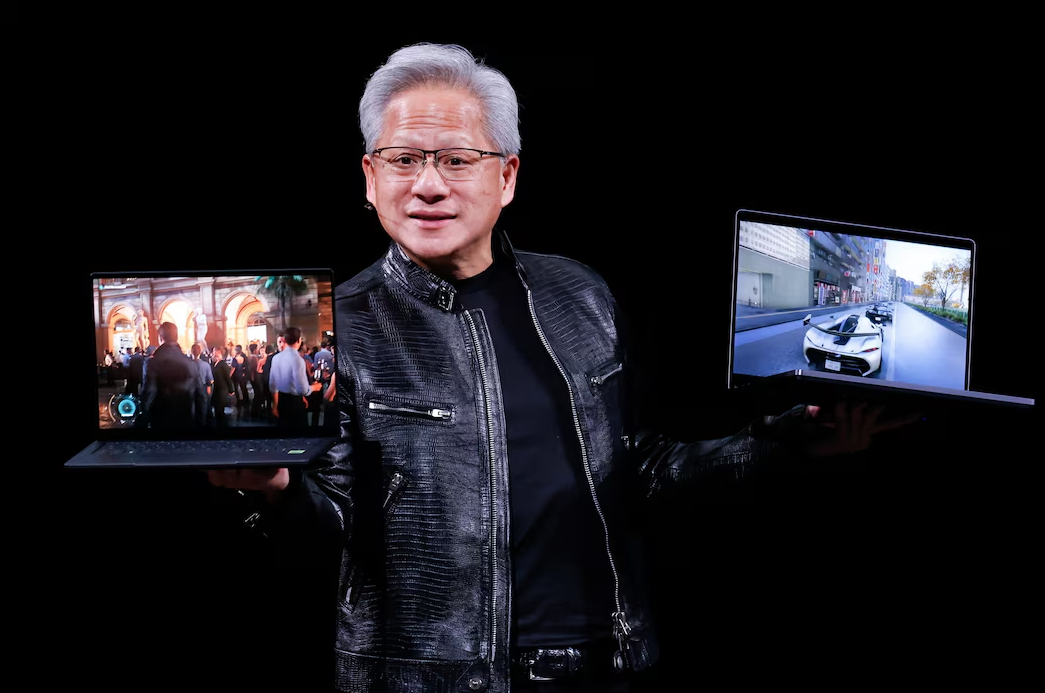
TAIPEI, Taiwan (TechGenez) – Nvidia has launched a new chip designed to bring advanced artificial intelligence capabilities directly into laptops and desktop computers, intensifying competition with AMD, Intel, and Apple in the rapidly evolving AI PC market.
Nvidia CEO Jensen Huang unveiled the RTX Spark chip at the Computex technology conference in Taiwan on Monday, describing it as a key part of a three-year collaboration with Microsoft to “reinvent the PC” for the AI era.
The chip enables AI agents to run locally on personal devices rather than relying primarily on cloud computing, promising faster responses, enhanced privacy, and new capabilities for users.
Key Features and Partnerships
The RTX Spark chip was developed in collaboration with Taiwan’s MediaTek. Industry analysts say it represents a significant step toward making personal computers truly intelligent by supporting autonomous AI agents that can perform complex tasks independently.
Neil Shah, co-founder of Counterpoint Research, called the launch a potential turning point for the PC industry. “The RTX Spark looks to transform the traditional app-centric PC into a real useful Agentic AI personal computer which will eventually be in every home in coming years as private edge AI agents become pivotal,” he said.
Huang also highlighted Nvidia’s new Vera central processing unit (CPU), designed specifically for AI agents. Early adopters of the Vera CPU include OpenAI, Anthropic, and SpaceX.
Strategic Shift Toward AI PCs
The announcements underscore Nvidia’s growing focus on the personal computing segment as the industry moves toward “agentic AI” — systems capable of acting autonomously rather than simply responding to user prompts.
Qualcomm CEO Cristiano Amon, speaking ahead of Computex, described 2026 as “the year of agents,” noting that device architectures must evolve to support always-on, autonomous AI operations.
Huang used much of his keynote to emphasize how the new chips will enable more powerful and efficient AI experiences on consumer devices, dismissing concerns that AI would reduce demand for software engineers and arguing instead that the technology would drive greater hiring by boosting productivity.
Market Reactions
Shares of rival chipmakers reacted negatively to the news in pre-market trading. AMD and Intel fell nearly 4%, Qualcomm dropped almost 7%, while Apple shares declined 0.6%. Microsoft, Nvidia’s key partner in the AI PC initiative, rose more than 3%.
The moves reflect investor expectations that Nvidia’s push into AI-enabled PCs could intensify competition across the semiconductor industry.
Broader Context and Investment Plans
Huang, who was born in Tainan, Taiwan, announced plans last week to invest around $150 billion annually in the island, calling it the epicenter of the AI revolution. The Computex speech came shortly after he joined a high-level U.S. business delegation to Beijing with President Donald Trump.
Nvidia’s expansion into PC processors and CPUs signals its ambition to extend dominance beyond data centers into consumer and edge computing markets, a segment valued at hundreds of billions of dollars.
Challenges
While the RTX Spark and Vera chips position Nvidia strongly in the emerging AI PC category, the company faces stiff competition from established players with deep roots in personal computing. Success will depend on ecosystem support from software developers, device manufacturers, and cloud providers.
Technical challenges remain in balancing performance, power efficiency, and heat management within compact consumer devices.
Outlook
The launch is expected to accelerate the adoption of AI features in mainstream laptops and desktops throughout 2026 and beyond. Analysts anticipate a wave of new AI PC models from major manufacturers powered by Nvidia’s latest technology.
As the industry shifts toward fully autonomous AI agents, Nvidia’s latest offerings could play a central role in defining the next generation of personal computing.
Conclusion
Nvidia’s introduction of the RTX Spark chip marks a bold move to embed powerful AI capabilities directly into everyday personal computers. With strong backing from Microsoft and growing momentum around agentic AI, the company is positioning itself at the forefront of a fundamental transformation in how users interact with their devices.