



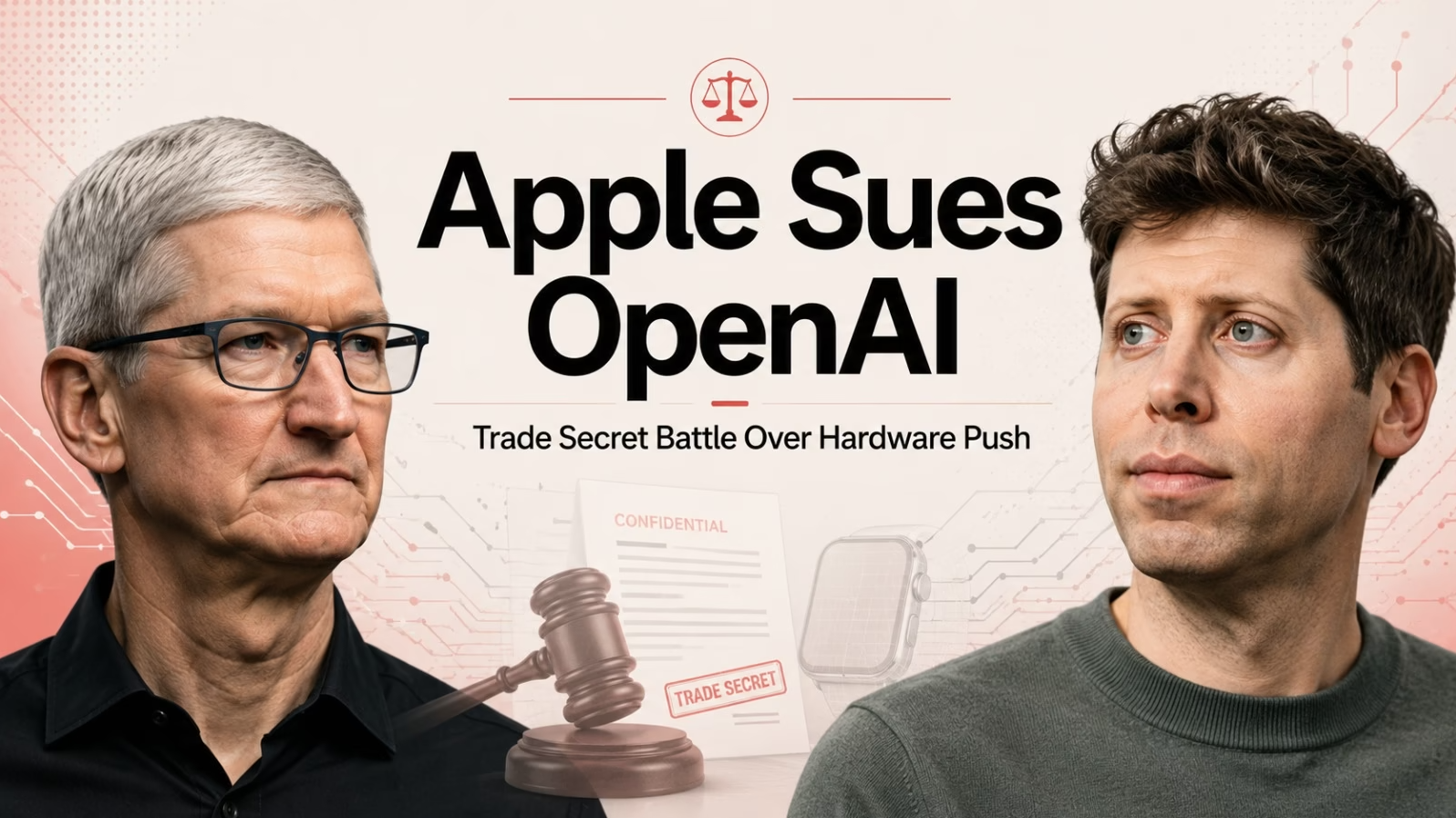
SAN JOSE, California (TechGenez) – Apple has filed a federal lawsuit against OpenAI in Northern California, accusing the company of stealing its trade secrets to help build its own consumer hardware.
The legal action marks a sharp reversal for the two companies, which once worked closely together. In 2024, ChatGPT was integrated into Apple Intelligence, and OpenAI CEO Sam Altman visited Apple’s headquarters to celebrate the partnership.
Relations between the companies have cooled since OpenAI announced plans to enter the hardware business last year. The AI lab acquired former Apple designer Jony Ive’s startup IO Products for $6.4 billion.
Apple’s Allegations
Apple claims that at every level of OpenAI — from the technical staff to the Chief Hardware Officer — and in coordination with business partners, the company has been stealing Apple’s trade secrets and confidential information.
The lawsuit focuses on former Apple employees who have joined OpenAI. Apple says OpenAI’s hardware chief, Tang Tang, a former Apple vice president, has asked job candidates still working at Apple to bring “actual parts” from Apple to interviews as part of “show and tell” sessions.
Apple also alleges that OpenAI coached departing employees on how to evade security processes when leaving the company and that Chang Liu, a former Apple employee who joined OpenAI, stole an Apple laptop.
The suit also claims OpenAI is asking hardware firms to perform a metal finishing technique that Apple developed, while misleading the partner into believing it had permission to do so.
The Impact on Apple Intelligence
Apple’s updated Siri assistant, which is expected to roll out this fall, is now based on Google’s Gemini AI models instead of OpenAI’s technology. The company has said it made this change to maintain its own independent development path.
The lawsuit does not directly mention the ChatGPT integration in Apple Intelligence, but it adds to the growing legal and commercial tensions between the two AI leaders.
Industry Reactions
A representative for OpenAI said the company has “no interest in other companies’ trade secrets” and remains focused on building innovative technology that empowers people everywhere.
Apple did not comment on whether the lawsuit will affect its partnership with OpenAI. The company is seeking damages, court orders to stop the use of its trade secrets, and other remedies.
Background
The lawsuit comes two months after OpenAI won a high-profile trial against Elon Musk, Tesla, and SpaceX CEO. A jury ruled that Musk had waited too long to sue the AI lab over claims that Altman and the company reneged on a non-profit mission.
Apple’s complaint names IO Products, the company acquired by OpenAI, as well as several individuals, including Tang Tang and Chang Liu.
The case adds another layer of legal risk to OpenAI as it prepares for what is expected to be a major initial public offering. Apple continues to focus on its own hardware innovations while exploring new partnerships for its AI-powered features.
Conclusion
Apple’s lawsuit against OpenAI over alleged trade secret theft highlights the growing friction between the two companies. As both strive to advance artificial intelligence, the legal battle serves as a reminder of the intense competition and the high stakes involved in protecting intellectual property in the technology industry.