





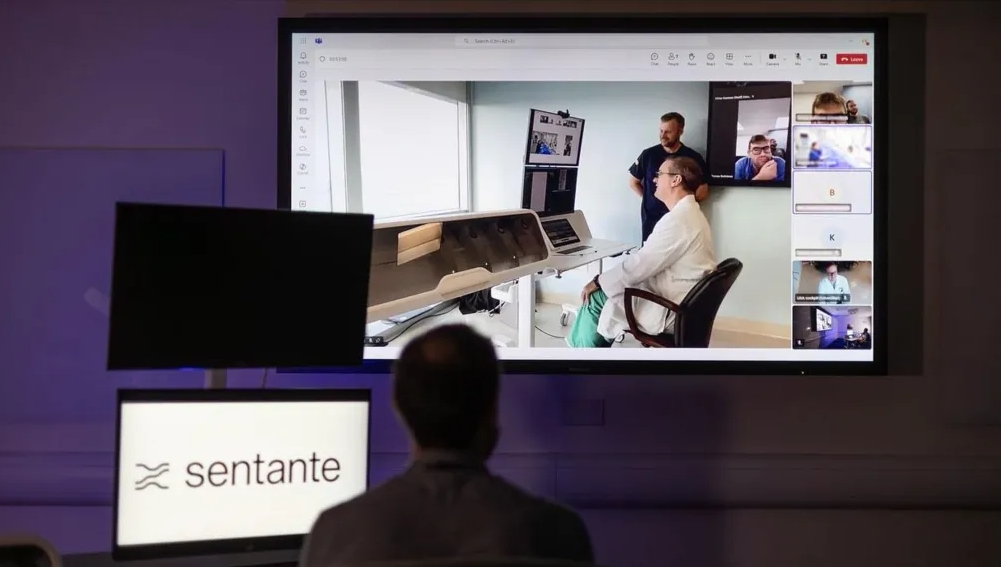
(TechGenez) – In a breakthrough that could revolutionize stroke care worldwide, surgeons from Dundee, Scotland, and Jacksonville, Florida, have successfully completed the first-ever remote robotic thrombectomy procedure on a human body, spanning over 4,000 miles (6,400 km) with just a 120-millisecond delay.
The procedure, conducted last month using Lithuanian firm Sentante’s robotics system, demonstrated the full steps of clot removal known as mechanical thrombectomy for ischemic strokes, on donated human cadavers. Led by Prof. Iris Grunwald at the University of Dundee and Dr. Ricardo Hanel in Florida, the test overcame key challenges in real-time connectivity and precision, offering hope for faster, more accessible treatment in underserved areas.
“This felt like witnessing the first glimpse of the future,” said Prof. Grunwald. “Where previously this was thought to be science fiction, we demonstrated that every step of the procedure can already be done.”
Procedure Details
The world-first operation targeted ischemic strokes, where a clot blocks an artery, starving the brain of oxygen and killing cells at a rate of 1.9 million per minute. Thrombectomy involves threading catheters and wires through blood vessels to extract the clot, restoring flow within a critical six-hour window.
In the test, Grunwald and Hanel used Sentante’s system to control the tools remotely. A local medic in Dundee attached the wires to cadavers donated bodies less than three years old and embalmed, with simulated blood flow while the Florida surgeon directed precise movements via the robot. Live X-rays guided the process, with Nvidia and Ericsson ensuring ultra-low latency connectivity.
The full procedure, from incision to clot removal, was completed successfully on four cadavers, validating each step in a human vascular system for the first time. Previous trials used silicon models, 3D prints, and animals, but this marked the leap to real anatomy.
Dr. Hanel remarked: “To operate from the US to Scotland with a 120 millisecond lag—a blink of the eye—is truly remarkable.”
Sentante CEO Edvardas Satkauskas added: “It feels amazing… Sometimes, the future is way closer than we think.”
Technology and Challenges Overcome
Sentante’s robotics replicate the surgeon’s hand movements exactly, requiring only 20 minutes of training. The AI-enhanced system predicts catheter paths and adjusts for satellite lag, a feat powered by Nvidia’s computing and Ericsson’s 5G networks.
Key hurdles included maintaining precision over distance and simulating real blood flow. The team circulated fluid mimicking human blood through the cadavers’ vessels, ensuring realistic conditions. The 120ms delay—faster than a human blink—proved negligible for the robot’s automated corrections.
This transatlantic test addressed global inequities: In Scotland, only 2.2% of ischemic stroke patients (212 of 9,625 last year) received thrombectomy, available just three sites. UK-wide, it’s 3.9%. Remote tech could bring expert care to rural or under-resourced areas, saving lives by slashing response times.
Significance and Future Implications
Stroke is a leading cause of death and disability, killing 6.5 million globally yearly, per WHO. Every six-minute delay in thrombectomy cuts good outcomes by 1%. By decoupling surgeons from location, this innovation could “rebalance the inequity in stroke treatment,” said Juliet Bouverie, CEO of the Stroke Association.
The Dundee-Jacksonville feat is a “game changer,” potentially allowing specialists to treat patients from home or across continents. The team plans clinical trials next year, pending regulatory approval, with full patient deployment possible by 2027.
Prof. Grunwald envisions: “This could make thrombectomy available everywhere, saving brain cells and lives.”
Broader Context
Remote surgery isn’t new robots like Intuitive Surgical’s da Vinci have enabled telesurgery since 2001 but this is the first full thrombectomy on a human body. It builds on Sentante’s 2024 animal tests and 3D model trials.
The project, funded by the UK’s Innovate UK and U.S. grants, highlights growing U.S.-UK collaboration in medtech. Stroke care disparities persist: In the U.S., only 5-10% of eligible patients get thrombectomy, per AHA data.
Global medtech investment hit $50 billion in 2025, per McKinsey, with AI robotics driving 20% growth.
Challenges
Regulatory approval for live patients could take 2-3 years, with FDA and MHRA demanding extensive trials. Connectivity in remote areas remains a hurdle, though 5G/6G advances help.
Ethical issues include surgeon training and liability across borders.
Quotes
Prof. Grunwald: “We demonstrated every step is possible. This could change stroke care forever.”
Dr. Hanel: “Operating across 4,000 miles with minimal lag is remarkable.”
Juliet Bouverie: “A remarkable innovation to rebalance stroke treatment inequity.”
Edvardas Satkauskas: “The future is way closer than we think.”
Broader Industry Trends
- Remote surgery market projected to $15 billion by 2030, up 25% annually, per Grand View Research.
- AI in robotics grew 40% in 2025, per IDC, with Nvidia powering 60% of systems.
- U.S.-UK medtech partnerships rose 20%, per BIO data.
Outlook
Clinical trials start 2026, with patient use by 2027. Success could expand to other procedures, saving 1 million lives yearly, per WHO estimates.
This Dundee-Florida triumph signals a new era in global healthcare.