





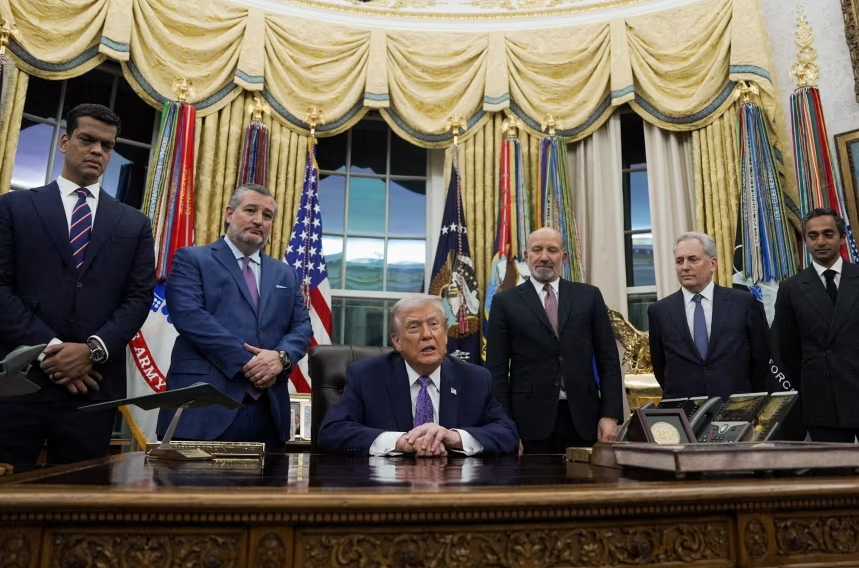
WASHINGTON – President Donald Trump signed an executive order, directing federal agencies to challenge state-level artificial intelligence regulations that conflict with national policy, asserting federal preemption to foster U.S. leadership in AI.
The order, “Eliminating State Law Obstruction of National Artificial Intelligence Policy,” creates an AI Litigation Task Force, ties discretionary funding to compliance, and calls for a uniform federal framework. It criticizes state laws for creating patchwork regulation, embedding ideological bias, and impinging on interstate commerce.
The move targets measures like Colorado’s algorithmic discrimination ban, which the order claims could force AI models to produce false outputs.
Order Provisions
The executive order outlines aggressive steps to centralize AI governance:
- AI Litigation Task Force: Attorney General to establish within 30 days, focused solely on challenging conflicting state laws on constitutional grounds.
- State Law Evaluation: Commerce Secretary to publish within 90 days identifying “onerous” laws, including those mandating altered truthful outputs or First Amendment violations.
- Funding Restrictions: Tie BEAD broadband funds and discretionary grants to states avoiding or not enforcing conflicting AI laws.
- Federal Standards: FCC to explore reporting/disclosure rules preempting states; FTC to clarify deception prohibitions preempting bias mandates.
- Legislation: Advisors to draft bill for uniform federal framework, preserving state roles in child safety and procurement.
The order revokes prior barriers and emphasizes AI’s role in security and economy.
Administration Response
White House: “This ensures minimally burdensome national standards to win the AI race.”
Trump: “States can’t hold back AI greatness—America will lead!”
The order invokes Supremacy and Commerce Clauses.
Broader Context
States have filled federal voids: California passed transparency bills, Colorado banned algorithmic discrimination, New York proposed bias audits. The order claims such laws fragment compliance, embed bias (e.g., forcing false outputs to avoid disparate impact), and regulate extraterritorially.
It aligns with Trump’s January 2025 order removing barriers and reflects competition with China. Tech groups support uniformity; civil rights advocates fear reduced protections.
Challenges
- Legal battles expected: States defend consumer rights jurisdiction.
- Preemption faces Supreme Court scrutiny amid federalism debates.
- Enforcement requires agency coordination and funding.
- International alignment complicated with EU’s strict AI Act.