



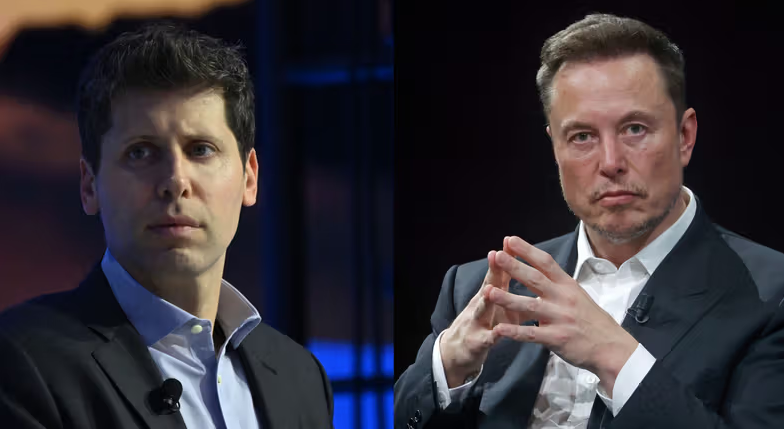
(TechGenez) – Elon Musk and OpenAI Chief Executive Sam Altman are set to face off in court this week in a closely watched trial that could shape the future of one of the world’s most valuable artificial intelligence companies and test the legal boundaries of nonprofit governance in Silicon Valley.
The case, stemming from Musk’s lawsuit against OpenAI, Altman, President Greg Brockman and Microsoft, centers on whether OpenAI abandoned its original nonprofit mission when it adopted a for profit structure and later converted into a public benefit corporation.
Musk, who co founded OpenAI in 2015 and helped fund its early years, alleges the company wrongfully shifted from a mission focused on safe, open AI for the public good into a profit driven enterprise benefiting private investors. He is seeking remedies that include returning OpenAI to its previous nonprofit structure, removing Altman and Brockman from leadership roles and awarding damages he has said should go back to OpenAI’s nonprofit entity.
OpenAI has rejected the claims, arguing Musk himself once supported a for profit model and that the lawsuit is motivated by competition, given Musk now leads rival AI startup xAI. The company has also said the structural changes were necessary to raise the capital required to build advanced AI systems.
A High Stakes Trial for the AI Industry
The trial comes at a pivotal moment for OpenAI, which faces growing competition from rivals including xAI, Google and Anthropic, while investors speculate about a possible blockbuster public offering. Legal experts say the outcome could have implications far beyond OpenAI, potentially influencing how mission driven technology organizations structure themselves as they scale.
At issue is whether OpenAI’s transition violated charitable trust principles or represented a legitimate evolution of a company facing enormous capital demands.
“This case raises a broader question about whether a company can market itself as a public interest project and later pursue a different structure without breaching its original obligations,” legal analysts have noted.
Judge Yvonne Gonzalez Rogers is expected to oversee proceedings, while jurors will provide advisory findings on liability before the judge determines any remedies. Jury selection begins Monday, with a larger than usual pool expected because of the challenge of finding impartial jurors in a case involving two of the most recognizable figures in technology.
Star Witnesses Expected
The witness list is expected to include Musk, Altman, Brockman and Satya Nadella, potentially turning the trial into one of the most high profile courtroom confrontations in tech in years.
Evidence is expected to include internal emails, text messages and correspondence dating back to OpenAI’s founding, with both sides likely to focus on whether Musk supported commercial restructuring before leaving the company in 2018.
Musk claims he contributed roughly $44 million in OpenAI’s early years and that the organization’s later direction betrayed commitments made at its founding. OpenAI has countered that Musk left after disputes over control and has framed the lawsuit as an attempt to undermine a competitor.
Implications for OpenAI’s IPO Ambitions
Investors are watching closely because a ruling in Musk’s favor could complicate or derail OpenAI’s expected IPO plans. Analysts say uncertainty around governance, leadership or corporate structure could affect valuation and delay market ambitions.
A ruling forcing OpenAI to unwind elements of its structure or remove executives would also introduce operational risks at a time when the company is racing to commercialize AI products and defend market share. Some analysts view the litigation as equally strategic for Musk, whose xAI is expanding aggressively in generative AI and infrastructure.
“This is not just a legal battle, it is a competitive battle over influence in the AI market,” one analyst said.
More Than a Personal Feud
The trial also reflects a broader ideological divide over artificial intelligence. Musk has increasingly criticized OpenAI for becoming too closed and commercially driven, while Altman has defended scaling through partnerships and capital raising as necessary for building safe and competitive AI.
That philosophical clash may be as important as the legal claims. The jury is expected to begin deliberations by May 12. For the AI industry, the verdict may determine more than whether Musk or Altman prevails.
It may help define who controls the future of artificial intelligence, and under what rules.