



(TechGenez) – The Forbes 30 Under 30 list has long been a launchpad for young entrepreneurs, spotlighting rising stars in tech and finance. But a dark underbelly has emerged: multiple honorees, hailed as the next generation of innovators, have ended up behind bars for frauds and scams exceeding $18.5 billion in losses, according to tech entrepreneur Chris Bakke’s viral tally.
From Sam Bankman-Fried’s $8 billion FTX collapse to Charlie Javice’s $175 million JPMorgan deception, these cases expose the perils of unchecked ambition in Silicon Valley. As of 2025, at least six Forbes 30 Under 30 CEOs have been convicted or charged, raising questions about the list’s vetting and the startup world’s “fake it till you make it” culture.
“This isn’t coincidence. It’s a symptom of hype-driven funding,” said Harvard Business School professor Noam Wasserman. “Forbes amplifies the myth, but fraud thrives in the shadows.”
The Forbes Curse: High-Flyers to Felons
The list, launched in 2011, has celebrated 1,500+ talents, raising $5.3 billion collectively. Yet, a disproportionate number have crashed spectacularly.
Sam Bankman-Fried (Finance, 2021)
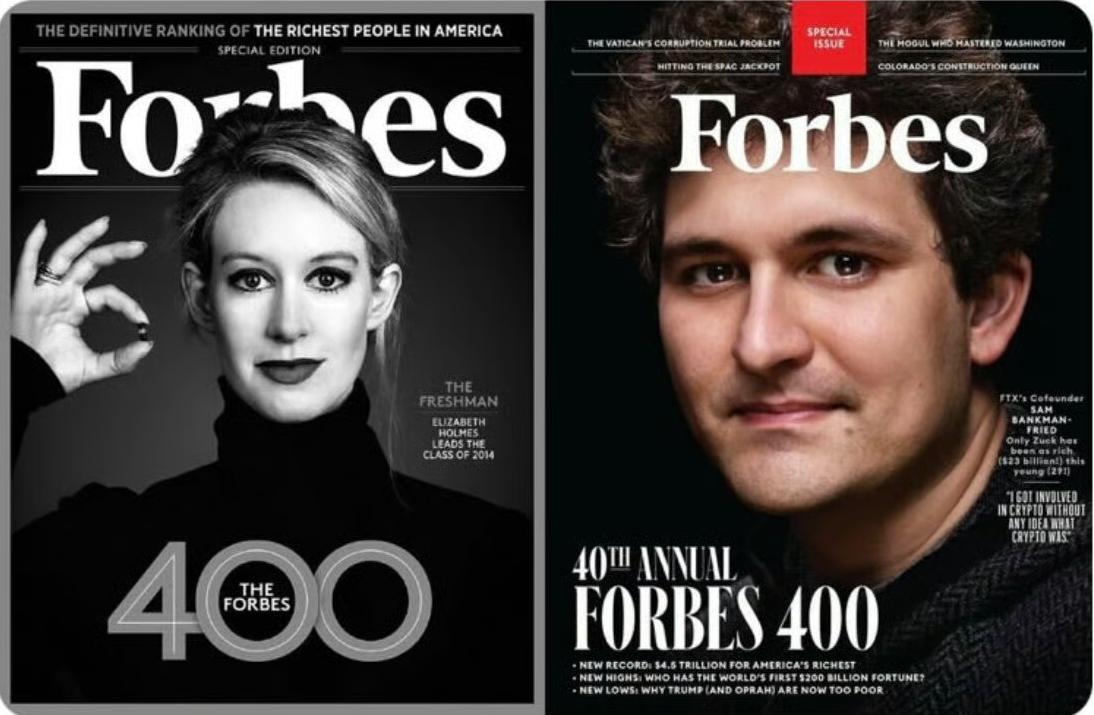
The once-charismatic founder of cryptocurrency exchange FTX, Sam Bankman-Fried was celebrated as a crypto prodigy with a net worth exceeding $26 billion at age 29. His downfall came with the November 2022 collapse of FTX, which revealed an $8 billion hole in customer funds. Prosecutors accused him of using Alameda Research, his hedge fund, as a personal piggy bank, diverting billions for luxury real estate in the Bahamas, political donations, and speculative investments.
Convicted on seven counts of fraud and conspiracy in November 2023, the 32-year-old was sentenced to 25 years in federal prison in March 2024. From a Forbes cover star to inmate #14347-138 at MDC Brooklyn, SBF’s appeal is ongoing, but his legacy is a cautionary tale of crypto hubris.
Elizabeth Holmes (Healthcare, 2015)
Elizabeth Holmes, the youngest self-made female billionaire on Forbes’ list at age 31, founded Theranos with a promise of revolutionary blood-testing technology. Valued at $9 billion, the company claimed its device could run hundreds of tests from a single drop of blood. It unraveled in 2015 when Wall Street Journal investigations revealed the tech was fake, leading to fraud charges.
Convicted in 2022 on four counts of wire fraud, Holmes was sentenced to 11 years and 3 months in prison, serving at FPC Bryan. Released in 2025 after a reduced sentence, her story inspired books, documentaries, and a TV series, symbolizing the biotech bubble’s burst.
Charlie Javice (Finance, 2019)
Charlie Javice built Frank as a revolutionary student aid platform, claiming to simplify FAFSA applications for millions. At 26, she sold the company to JPMorgan Chase for $175 million in 2021, earning a spot on Forbes’ list and a reputation as a fintech wunderkind. The deal unraveled when JPMorgan discovered Frank had only 300,000 real users, not the 4.25 million Javice claimed.
She allegedly paid a data scientist $18,000 to fabricate user lists and hired a professor to falsify emails. Charged with bank fraud, securities fraud, and wire fraud, the 33-year-old faces up to 30 years in prison. Her trial, set for 2026, has become a symbol of inflated startup metrics and due diligence failures.
Caroline Ellison (Finance, 2022)
As co-CEO of Alameda Research and Sam Bankman-Fried’s former girlfriend, Caroline Ellison played a central role in the FTX scandal. The 28-year-old Stanford graduate helped orchestrate the diversion of $8 billion in customer funds to cover Alameda’s trading losses and personal expenses. In a dramatic plea deal, she testified against SBF, detailing how he instructed her to manipulate balance sheets and lie to lenders.
Pleading guilty to seven felony counts in December 2022, Ellison faces up to 110 years but is expected to receive 5 to 10 years due to cooperation. Her inclusion on the 2022 Forbes list, just months before the collapse, underscored the rapid rise and fall of FTX’s inner circle.
Martin Shkreli (Healthcare, 2012)
Long before “Pharma Bro” became a meme, Martin Shkreli was a 29-year-old hedge fund manager turned biotech CEO. After acquiring Turing Pharmaceuticals, he infamously raised the price of Daraprim, a life-saving antiparasitic drug, from $13.50 to $750 per pill, a 5,000% increase. The backlash was swift, but his real crimes came later: defrauding investors in his hedge funds and Retrophin to cover personal losses.
Convicted in 2017 on securities fraud and conspiracy charges, the 42-year-old served seven years in prison, released in 2022. He was also banned for life from the pharmaceutical industry and ordered to repay $64.6 million. Shkreli remains a polarizing figure, active on X despite legal restrictions.
Manish Lachwani (Consumer Tech, 2017)
Manish Lachwani founded HeadSpin, a mobile app testing platform, and raised $100 million from top VCs like ICONIQ and GV by claiming $100 million in annual revenue. In reality, the company generated just $2.5 million. Lachwani allegedly backdated contracts, forged signatures, and inflated metrics to secure funding. Arrested in 2020, the 47-year-old pleaded guilty to wire and securities fraud in 2023.
Sentenced to 18 months in federal prison in 2024, he was ordered to pay $20 million in restitution. His case highlighted the dangers of “growth at all costs” in Silicon Valley’s unicorn chase.
Chris Kirchner (Enterprise Tech, 2018)
Chris Kirchner’s Slync.io promised to revolutionize logistics with AI-driven supply chain software. The 35-year-old raised $76 million from Goldman Sachs and others, but spent lavishly, $25 million on private jets, Lamborghinis, and a $16 million Dallas mansion. When investors demanded transparency, Kirchner fired the board and went into hiding.
Arrested in 2022, he was convicted of wire fraud and money laundering in 2024. Sentenced to 20 years, the longest term among Forbes alumni, he is appealing from FCI Fort Worth. Slync collapsed, leaving employees unpaid.
Joanna Smith-Griffin (Education, 2021)
Joanna Smith-Griffin founded AllHere, an AI chatbot for student absenteeism, and claimed partnerships with 100+ school districts. In reality, she had fewer than 10 clients and fabricated revenue to raise $17 million. Charged with securities and wire fraud in November 2024, the 31-year-old faces up to 30 years. Her arrest came after whistleblowers exposed fake contracts and inflated user numbers. AllHere shut down in 2025, marking the latest edtech scandal.
Company Response
Forbes distanced itself: “We celebrate achievement, not endorse actions. These cases are tragic but isolated,” a spokesperson said.
DOJ’s Damian Williams: “Fraudsters hide behind innovation; justice catches up.”
Broader Context
Forbes 30 Under 30 has faced scrutiny since 2016 Theranos scandal (Elizabeth Holmes). A 2023 Guardian analysis found 10% of alumni in fraud probes.
VC funding hit $300 billion in 2025, per CB Insights, but 90% of startups fail, per Harvard Business Review. Fraud cases like these erode trust, with SEC probes up 25% in tech.
Challenges
- Weak due diligence: Forbes relies on nominations; critics call for stricter vetting.
- Startup pressure: “Fake it till you make it” culture, per Wasserman, fuels deception.
- Regulatory gaps: SEC’s 2025 rules mandate transparency, but enforcement lags.
Quotes
Chris Bakke: “Forbes 30 Under 30 raised $5.3B… and scams worth $18.5B.”
Gina Cass-Gottlieb, ACCC: “Innovation mustn’t excuse fraud.”
Broader Industry Trends
- Fraud cases in tech up 40% since 2020, per FBI.
- Forbes alumni raised $5.3B, but 5% faced charges, per Guardian.
- AI startups saw 20% fraud probes in 2025, per SEC.
Outlook
Forbes may tighten criteria for 2026 list. DOJ predicts more charges as AI hype fades. Wasserman: “Celebrate grit, not glamour. Vet the visionaries.”