





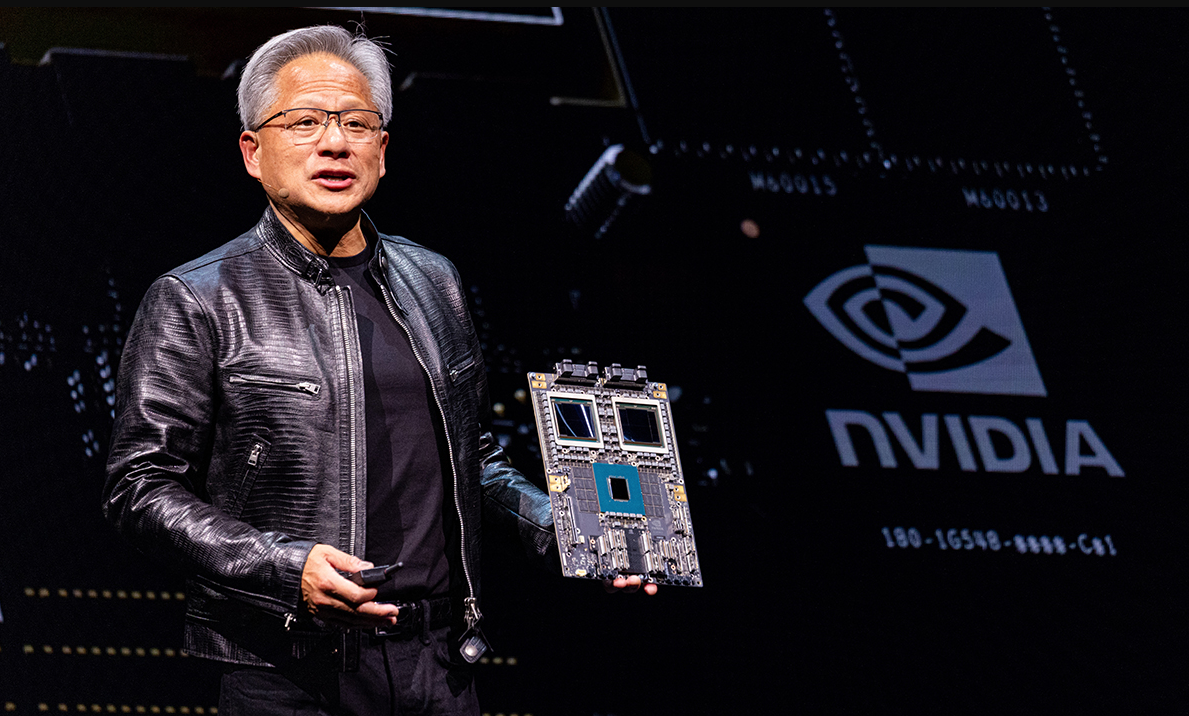
SAN FRANCISCO, Oct 29 (TechGenez) – Nvidia Corp became the first company in history to close above a $5 trillion market capitalization on Wednesday, capping a meteoric rise driven by investor optimism over its AI chip dominance and President Donald Trump’s comments on potential sales to China.
Shares closed up 2.99% at $207.04, valuing the chipmaker at $5.02 trillion, surpassing previous highs set by Microsoft and Apple. The milestone came after Trump, ahead of a planned meeting with CEO Jensen Huang, said the leaders would discuss Nvidia’s Blackwell AI processors, hinting at eased export restrictions.
Huang’s Tuesday keynote at Nvidia’s GTC event in Washington, D.C., announced partnerships with the U.S. Department of Energy, Uber, Eli Lilly, Nokia, Palantir, Oracle, Cisco, T-Mobile, Amazon, Foxconn, Caterpillar, and Belden, plus a new NVQLink architecture for quantum supercomputers with Rigetti and IonQ. He forecasted $500 billion in GPU orders through 2026.
Nvidia’s ascent underscores the AI boom, with its market value exceeding the GDP of all but the U.S. and China, per World Bank data.
Financial Details
Nvidia’s shares rose as much as 5.6% intraday to over $212 before closing at $207.04, a 2.99% gain, pushing its valuation to $5.02 trillion from $4.88 trillion the prior day.
The stock has surged over 50% year-to-date and more than doubled from April lows, despite U.S. trade tensions. AI-related enterprises have driven 80% of U.S. stock market gains in 2025, per S&P Dow Jones Indices.
Nvidia’s Q2 revenue hit $30 billion, up 122%, with data center sales comprising 88%. Analysts expect Q3 results on November 20 to show continued momentum.
Company Response
Huang told attendees at GTC: “We’re at the dawn of the AI era, and our $500 billion in GPU orders through 2026 reflects the explosive demand.”
A Nvidia spokesperson highlighted the China comments: “President Trump’s remarks underscore the importance of our Blackwell processors in global AI leadership.”
The company announced seven new supercomputers with the Department of Energy, one using 10,000 Blackwell GPUs, and partnerships for self-driving cars, drug discovery, 6G tech, and robotics.
Broader Context
Nvidia’s rise from a graphics chip designer to AI titan has been propelled by euphoria over artificial intelligence and demand for its GPUs, powering models from OpenAI to Oracle.
It hit $1 trillion in June 2023, $4 trillion three months ago, and now $5 trillion, outpacing Microsoft and Apple, both above $4 trillion.
Trump reversed a July ban on Nvidia’s advanced chips to China, requiring a 15% revenue cut to the U.S. government, though no H20 chip sales have occurred yet.
The stock dipped in April amid Trump’s “Liberation Day” tariffs but rebounded on AI optimism.
Challenges
- Warnings of an AI bubble come from the Bank of England, IMF, and JPMorgan’s Jamie Dimon, who told the BBC uncertainty should be higher.
- Skeptics question if gains stem from “financial engineering,” as AI firms invest in each other—e.g., Nvidia’s $100bn in OpenAI last month.
- U.S.-China tensions persist, with export curbs on advanced chips, though Trump’s meeting with Xi Jinping could ease them.
Quotes
Huang at GTC: “We’re entering a new era of AI, with $500 billion in orders showing the scale of opportunity.”
Trump on Nvidia: “We’ll discuss Blackwells with Xi—great potential for U.S. innovation.”
Broader Industry Trends
- AI chip demand drives Nvidia’s surge, with global spending projected at $200 billion in 2025, per McKinsey.
- Nvidia holds 80-90% market share, but AMD and Intel are gaining.
- The S&P 500’s AI-fueled gains mark the biggest tech rally since the dot-com era.
- OpenAI and Oracle partnerships highlight Nvidia’s ecosystem.
Outlook
Nvidia’s Q3 earnings on November 20 could push the valuation higher, with analysts forecasting $35 billion revenue. Morgan Stanley sees $6 trillion by mid-2026 if AI adoption accelerates. As the first $5tn company, Nvidia symbolizes the AI era, but bubble risks loom.